
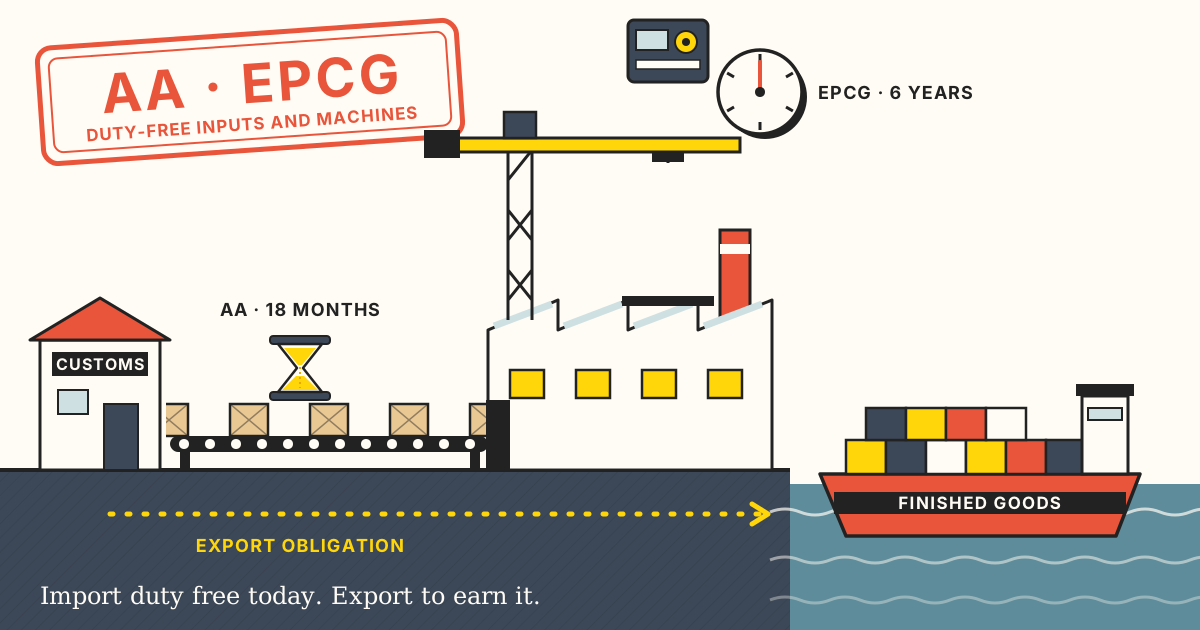
Advance Authorisation and EPCG both let an exporter import without paying customs duty, on a promise to export later. Advance Authorisation covers the inputs that go into your export product: the steel in a forged auto part, the yarn in a fabric, the chemicals in a dye. EPCG, short for Export Promotion Capital Goods, covers the machines you make it on. In both cases customs takes a bond, the duty you didn't pay hangs over the business until the export obligation is met, and the file closes only when DGFT gives you a discharge certificate.
From a distance the two schemes look alike. Up close they behave very differently. An Advance Authorisation runs on an 18-month clock and a value-addition test. EPCG runs on a six-year clock, a multiple of the duty you saved, and an average-exports test that most first-time holders don't see coming. Miss either obligation and the duty comes back with 15% interest.
This guide covers how each scheme works under the Foreign Trade Policy 2023 as amended up to October 2026, the obligation maths with worked numbers, the time limits and fees for extensions, how the authorisation is closed, what a shortfall costs, what happens to drawback and RoDTEP, and which scheme fits which kind of business.
Two schemes, one bargain
Both schemes are issued by the DGFT Regional Authority that has jurisdiction over your IEC, and given effect at the port by customs exemption notifications: Notification 21/2023-Customs for Advance Authorisation and Notification 26/2023-Customs for EPCG. The deal is the same in both:
- You get an authorisation that names what you may import, how much, and what you must export in return.
- The authorisation is registered at the port of import it names, and the imports and exports go through the ports listed in the notification. For our part of the country that list includes Chennai, Ennore and Kattupalli seaports, Chennai and Bengaluru airports, and inland container depots at Bengaluru, Irungattukottai, Tondiarpet and Hosur.
- Before the first import clears, you execute a bond with customs. Depending on your track record, it's backed by a bank guarantee of nil, 15%, 25% or 100% of the duty foregone (CBIC Circular 04/2025, which also moved these bonds to a single electronic all-India bond).
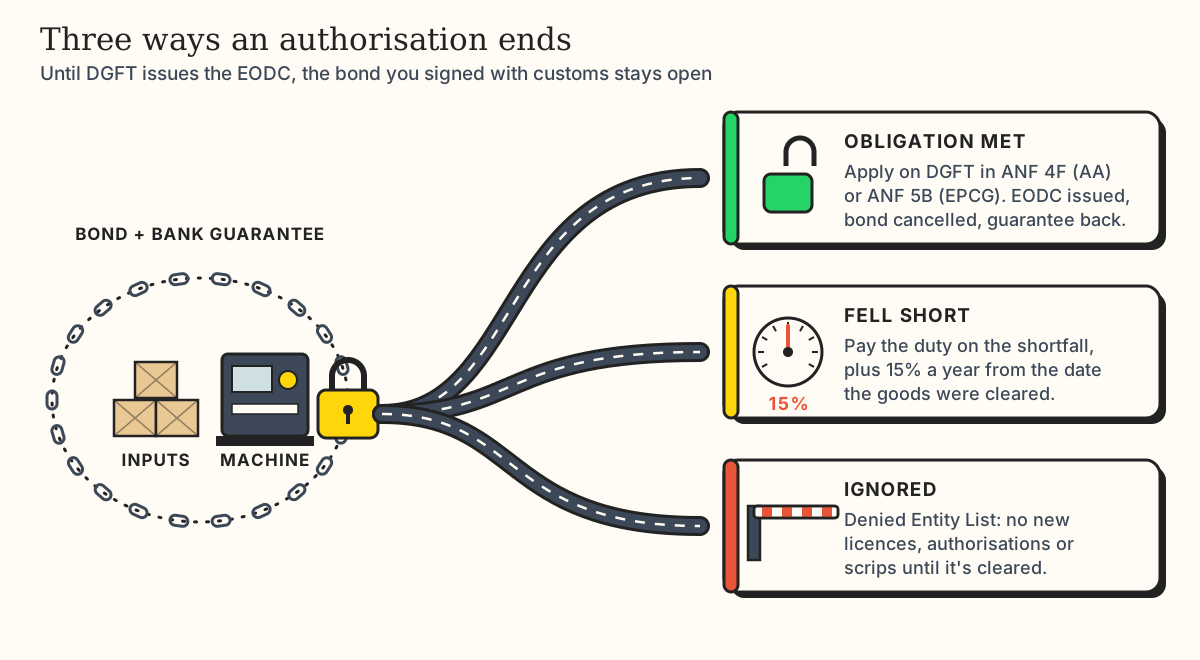
- You export within the time allowed, prove it to DGFT, and get an Export Obligation Discharge Certificate (EODC). Customs then cancels the bond.
You need a valid IEC and an RCMC from your Export Promotion Council to apply, and both application forms ask for the RCMC details. The application fee is small: ₹100 for MSMEs where the CIF value or duty saved is up to ₹1 crore, ₹5,000 above that, and one rupee per thousand for others, between ₹500 and ₹1 lakh (Appendix 2K).
The two schemes side by side
| Advance Authorisation | EPCG | |
|---|---|---|
| What comes in duty free | Inputs physically incorporated in the export product, plus fuel, oil and catalysts used up in making it | Capital goods for pre-production, production and post-production, including spares, moulds, dies, tools and bundled software |
| Duties exempted | Basic customs duty, additional duties, IGST, compensation cess, anti-dumping, safeguard and countervailing duty | Basic customs duty, additional duties when claimed, IGST and compensation cess |
| How the export obligation is set | Export of the resultant product, with at least 15% value addition | Six times the duty, taxes and cess saved, in FOB value, on top of your average exports |
| Time to import | 12 months, with one 12-month revalidation | 24 months, no revalidation |
| Time to export | 18 months from the date of issue | 6 years from the date of issue, at least half in years 1 to 4 |
| Extensions | Two of 6 months each, never beyond 12 months after the obligation period ends | Block and overall extensions, never beyond 8 years from issue |
| Can it be transferred? | No, not even after the obligation is met | The machines can't be sold or transferred until the obligation is complete |
| Closing form | ANF 4F | ANF 5B |
| If you fall short | Duty on unused inputs, plus 15% interest from the date of import | Duty in proportion to the shortfall, plus interest |
The policy sources for the table are FTP 2023 Chapter 4 and Chapter 5, with the procedures in Handbook of Procedures Chapter 4 and Chapter 5. The details follow.
How the Advance Authorisation scheme works
An Advance Authorisation lets you import, duty free, the inputs that are physically incorporated in your export product, with a normal allowance for wastage. Fuel, oil and catalysts consumed in making it can be allowed too (FTP para 4.03). It goes to a manufacturer exporter, or to a merchant exporter tied to a supporting manufacturer.
How much you can import: the norms
The quantity of inputs per unit of export comes from one of four places:
- SION, the Standard Input Output Norms DGFT notifies for common products.
- Self-declaration. If there's no SION, you declare your own norms and the Norms Committee ratifies them later. If the committee revises or rejects them, you pay duty and interest on the difference within 30 days (HBP para 4.07).
- Prior fixation by the Norms Committee for your specific product.
- Self-ratification, open to AEO-certified exporters and some status holders.
Norms are moving this year. Ad hoc norms ratified on or after 1 April 2015 are now valid until 31 March 2028 (Public Notice 07/2026-27). DGFT suspended the SIONs for food products in August 2025 (Public Notice 20/2025-26), and in September 2026 proposed suspending 544 SIONs that hadn't been used in three years (Trade Notice 26/2026-27). If your product relies on an old SION, check it before you plan around it.
The value-addition test
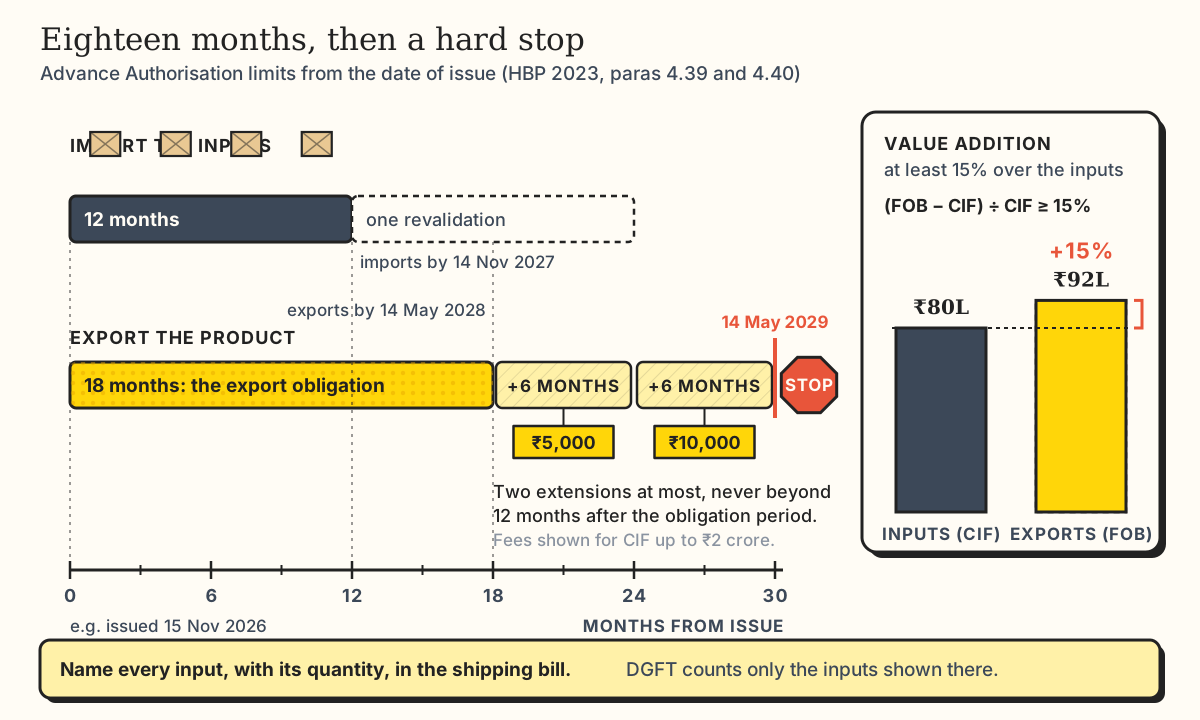
Exports must add at least 15% to the inputs:
Value addition = (FOB value of exports − CIF value of the duty-free inputs) ÷ CIF value of the inputs × 100
Inputs with a CIF value of ₹80 lakh therefore need exports of at least ₹92 lakh FOB. A few products are allowed less (they're listed in Appendix 4D), and some need more: 50% for tea, 25% for spices (FTP paras 4.08 and 4.09).
The rules that catch people
The inputs have to be named in the shipping bill. DGFT counts only inputs that are specifically shown, with quantities, in the shipping bill against the authorisation (FTP para 4.12). If the export item's description runs past the roughly 120 characters a shipping bill holds, the Regional Authority can now check the full description against your GST e-invoices (Trade Notice 32/2024-25). When we file a shipping bill against an Advance Authorisation, this is the part we check twice, because a missing input line can't be argued back into the redemption file later.
Actual user. The authorisation and the inputs imported against it can't be transferred, even after the export obligation is met (FTP para 4.16). Moving inputs to a job worker is allowed under the customs conditions.
IGST is exempt, but it ties you to physical exports. Under Notification 21/2023 the IGST and cess exemption on Advance Authorisation imports has no end date. The old 2015-20 sunset clause was removed in 2022. But if you take the IGST exemption, the obligation has to be met by physical exports or a few specified domestic supplies. Advance Authorisations for deemed-export supplies run under a separate notification, 22/2023-Customs, which doesn't exempt IGST at all.
Annual Requirement authorisations exist for SION products, if you've exported in each of the two previous financial years. The entitlement is up to 300% of the previous year's exports or ₹1 crore, whichever is higher (FTP para 4.07).
The Advance Authorisation clock
The time limits are short and fixed (HBP paras 4.39 and 4.40):
- Imports within 12 months of the date of issue, with one revalidation of another 12 months.
- Exports within 18 months of the date of issue. Defence, aerospace and nuclear items get 24 months, and project supplies run with the contract.
- Extensions: one of 6 months for a composition fee of ₹5,000, ₹10,000 or ₹15,000 depending on the CIF value (up to ₹2 crore, ₹2 to 10 crore, above ₹10 crore), and a second 6 months for ₹10,000, ₹20,000 or ₹30,000. Each time you declare that the unused inputs are still in stock. There is no third extension, and nothing beyond 12 months after the original obligation period ends.
Say an authorisation is issued on 15 November 2026. Imports must be in by 14 November 2027 (or by November 2028 with the one revalidation). Exports are due by 14 May 2028. With both extensions, the hard stop is 14 May 2029.
This year there was a one-off reprieve: every Advance Authorisation whose export obligation period expired between 1 March and 31 May 2026 was automatically extended to 31 August 2026, with no fee (Public Notice 51/2025-26). That window has closed, and nothing similar is open as of October 2026. If your product's export is banned or restricted after the authorisation is issued, the obligation period extends automatically for the length of the ban.
How the EPCG scheme works
EPCG lets you import capital goods at zero customs duty for pre-production, production and post-production. That includes complete or semi-knocked-down machines, bundled software, spares, moulds, dies, jigs, fixtures, tools, refractories, and catalysts for the initial charge plus one more. A negative list in Appendix 5F excludes some items (FTP para 5.01). The exemption covers basic customs duty, IGST and compensation cess, and additional duties when you claim them (Notification 26/2023).
It goes to manufacturer exporters, merchant exporters tied to supporting manufacturers, and service providers (FTP para 5.02). Some details matter from day one:
- The import window is 24 months from the date of issue, with no revalidation.
- The machines are tied to you until the obligation is complete and the EODC is issued. They can't be sold, leased or transferred before then (FTP para 5.03).
- You must prove installation. DGFT's procedures, amended in July 2024, give you three years from completing the imports to file an installation certificate from customs or an independent chartered engineer (Public Notice 15/2024-25). The customs notification still says six months, unless the Regional Authority extends it. Since the bond you signed is with customs, we'd get the certificate in within six months.
- You can source the machine in India. Buying from an Indian manufacturer against the authorisation cuts the specific export obligation by 25%, and the supplier gets deemed-export benefits.
The EPCG obligation, worked through
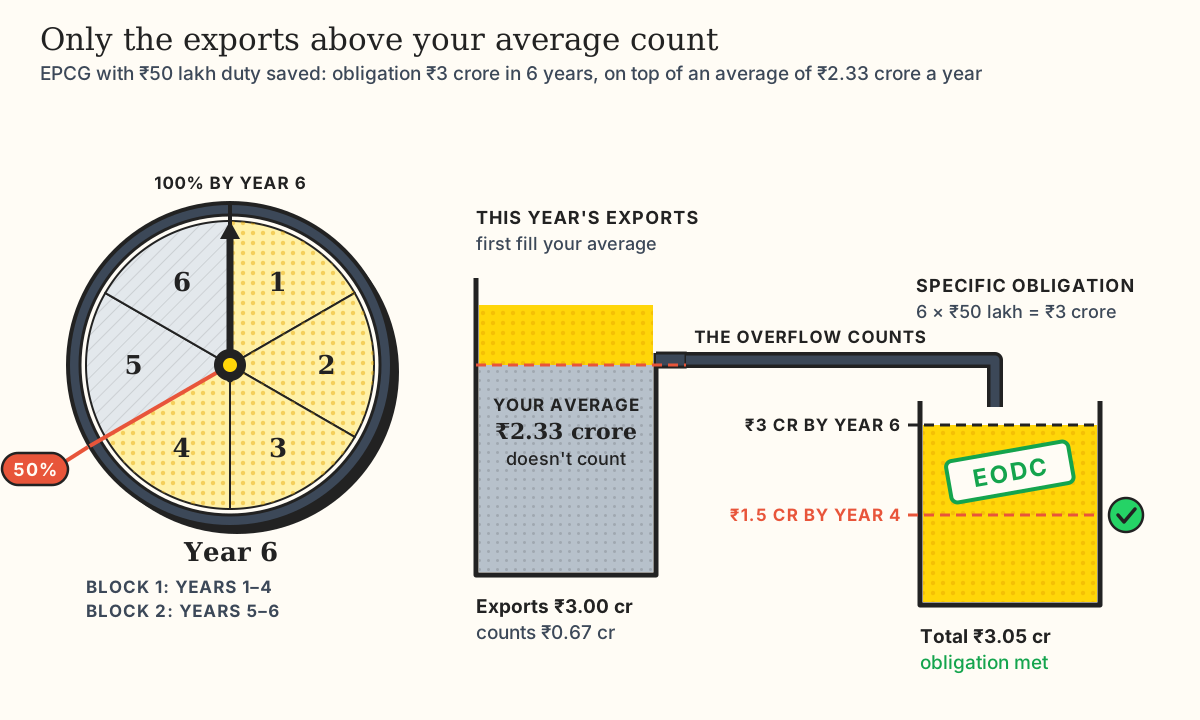
The headline rule is simple: export six times the duty, taxes and cess you saved on the capital goods, in FOB value, within six years of the date the authorisation was issued (FTP para 5.01(b)). At least 50% of that is due by the end of year 4, and the balance by the end of year 6 (HBP para 5.13).
"Duty saved" is the actual duty, taxes and cess you didn't pay on imported machines. For domestically sourced machines it's the notional customs duty on the FOR value. IGST you paid in cash, without taking input credit, isn't counted (FTP para 5.08). If you use up to 10% more than the duty saved shown on the authorisation, the obligation rises with it automatically. If you use less, it falls in proportion.
The part most people miss: the average export obligation
The specific obligation sits on top of your average export obligation, or AEO: the average of your exports of the same and similar products over the three licensing years before the authorisation. You have to keep your exports at that average every financial year until the obligation is complete, and only exports above the average count towards the six times (FTP para 5.04(c)).
Here is what that means in rupees. Take a precision-machining unit near Chennai that exports auto parts. Its EPCG authorisation for a new CNC line shows a duty saved of ₹50 lakh. Its exports of similar parts in the three years before the authorisation were ₹2.0 crore, ₹2.4 crore and ₹2.6 crore.
- Specific obligation: 6 × ₹50 lakh = ₹3 crore, of which ₹1.5 crore is due by the end of year 4.
- Average export obligation: (₹2.0 + ₹2.4 + ₹2.6 crore) ÷ 3 = ₹2.33 crore a year, every year.
| Year | Exports | Above the average (counts) | Running total |
|---|---|---|---|
| 1 | ₹2.60 crore | ₹0.27 crore | ₹0.27 crore |
| 2 | ₹2.80 crore | ₹0.47 crore | ₹0.73 crore |
| 3 | ₹2.90 crore | ₹0.57 crore | ₹1.30 crore |
| 4 | ₹2.90 crore | ₹0.57 crore | ₹1.87 crore, first block met |
| 5 | ₹2.85 crore | ₹0.52 crore | ₹2.38 crore |
| 6 | ₹3.00 crore | ₹0.67 crore | ₹3.05 crore, obligation met |
To discharge a ₹3 crore obligation, this unit exports ₹17.05 crore over six years. A brand-new exporter with no export history has no average to beat, so all its exports count. An established exporter whose business is flat has a much harder job than the "six times" headline suggests.
A few things change the numbers:
- Sectors with no average obligation. Handicrafts, handlooms, industries under the Khadi and Village Industries Commission, agriculture, aquaculture and fisheries, animal husbandry and dairying, floriculture and horticulture, poultry, viticulture, sericulture, carpets, coir and jute don't carry an AEO, though fishing boats and trawlers are excluded from that relief (FTP para 5.12).
- A bad year for your sector. If total exports of your sector or product group fall by more than 5% on the previous year, that year's average can be cut in proportion. DGFT tells the Regional Authorities which sectors qualify (HBP para 5.17). A strong year can also make up for a weak one within the same block.
- Reduced specific obligation. It's 25% less if you source the machine in India. It's 75% of normal if you export green technology products, a list that includes solar and wind equipment, LED lights, battery electric vehicles, water treatment plants and green hydrogen. It's 25% of normal for units in the North East, Jammu and Kashmir and Ladakh. Only one of these applies at a time (FTP paras 5.04, 5.10 and 5.11).
- Early fulfilment. If you export 75% of the specific obligation, plus your full average, within half the obligation period, the balance is written off (FTP para 5.09). It can't be combined with the green technology or North East reductions.
Closing the authorisation: the EODC
Neither authorisation closes by itself. You have to apply.
Advance Authorisation. File ANF 4F online on the DGFT portal within six months of the export obligation period ending, linking your shipping bills and e-BRCs. The file includes a statement of imports, exports and actual consumption certified by an independent chartered accountant. That certificate (Appendix 4H) is now signed digitally by the CA on the portal and attached to your application automatically (Trade Notice 21/2024-25). Customs runs its own, shorter clock: the notification asks for evidence of discharge within 60 days of the obligation period ending, unless the Deputy or Assistant Commissioner allows more time. Keep both dates in your diary.
EPCG. Report to the Regional Authority within three months of each block ending, and give customs the evidence within 30 days of each block. At the end, file ANF 5B online with a certificate in Appendix 5C from a chartered accountant, cost accountant or company secretary, the bills of entry (or invoices for machines bought in India) and proof that the installation certificate was filed on time. The Regional Authority is meant to decide within 30 days (HBP para 5.20).
The EODC goes from DGFT to customs electronically, and customs then cancels the bond and releases any bank guarantee. If you are paying duty voluntarily to regularise a shortfall, pay it through ICEGATE. Since 1 August 2026, DGFT recognises only voluntary payments that reach it from customs data on ICEGATE (Trade Notice 15/2026-27).
When you fall short
Advance Authorisation. You pay the customs duty on the inputs you didn't use towards exports, plus interest at 15% a year from the date the inputs were cleared (Notification 21/2023, condition (iv); HBP para 4.49). If you met the obligation in quantity but the value addition came in under the minimum, you deposit 1% of the shortfall in FOB value. That was 3% until July 2024 (Public Notice 14/2024-25). Restricted items carry an extra 10% of the CIF value.
EPCG. If the first block falls short and you haven't had it extended, you pay the duty in proportion to the unmet part of the block, with interest at 15% a year from the date the machines were cleared. Take the Chennai unit above. If it reached only ₹1 crore above its average by the end of year 4, against ₹1.5 crore due, the shortfall is ₹50 lakh of a ₹3 crore obligation. That's a sixth of the ₹50 lakh duty saved, or ₹8.33 lakh, plus four years of interest. The extension fee for the first block, if you apply within six months of the block ending, is ₹5,000 for an authorisation with duty saved up to ₹2 crore. Later requests cost more (HBP para 5.13(c)). Ask for the extension on time.
The overall six-year period can be extended by two years, either as two single years or in one go, for a composition fee that starts at ₹20,000 for smaller authorisations. Apply within six months of expiry. Later than that there's a late fee, and nothing goes beyond eight years from the date of issue (HBP para 5.16). Customs and DGFT also disagree on the deadline for paying a block shortfall: three months in the customs notification, six in the Handbook. Plan for three.
If nothing is done. The Regional Authority can place a defaulting firm on the Denied Entity List, which blocks every new licence, authorisation and scrip until the default is cleared (FTP para 2.14). Customs can enforce the bond, and penalty proceedings can follow. The last amnesty for export obligation defaults closed for applications on 31 December 2023 (Trade Notice 35/2023-24), and there isn't one open as of October 2026.
What happens to drawback and RoDTEP
The two schemes treat your other export benefits differently.
Under Advance Authorisation, All Industry Rate drawback doesn't apply to goods made or exported against the authorisation, because the inputs came in duty free (Notification 77/2023-Customs (N.T.), condition 9). A brand rate is still possible for duty-paid inputs outside the norms. RoDTEP is available for physical exports at the lower Appendix 4RE rates, and not for deemed exports. Both points are covered in our duty drawback guide and RoDTEP guide.
Under EPCG, nothing changes. Exports made with an EPCG machine can claim drawback and RoDTEP at the normal rates. Exports made under Advance Authorisation, drawback or RoDTEP also count towards the EPCG obligation (FTP para 5.04(e)).
That gives you a calculation to make before applying for an Advance Authorisation. On the duty-free inputs, you save the customs duty and don't have to pay IGST up front. On the export, you give up All Industry Rate drawback and drop from Appendix 4R to the lower 4RE rate of RoDTEP. For an input-heavy product the authorisation usually wins comfortably. For a product with modest imported content, it's worth working out both ways first.
Which one fits your business
Choose Advance Authorisation if imported inputs are a big share of what you export and the duty on them is real money. That might be an auto-component maker in Chennai importing alloy steel, an electronics assembler in Bengaluru bringing in components, or a chemical exporter importing intermediates. It's a working-capital tool: you stop paying duty upfront on stock that's going to leave the country anyway. It suits you best if a SION exists for your product, or your consumption norms are well documented.
Choose EPCG if you are buying machines and you're confident of exporting six times the duty saved, over and above your normal exports, within six years. It's a capital decision. If the export plan behind the machine isn't solid, EPCG works like a loan with a 15% penalty rate.
Hold both if you make and export at scale. Many manufacturers run an EPCG authorisation for a line and Advance Authorisations for the inputs that run through it, and the exports under the Advance Authorisation count towards the EPCG obligation too.
A few edge cases:
- Merchant exporters can use either scheme only if they're tied to a supporting manufacturer.
- Service providers can use EPCG, not Advance Authorisation.
- First-time exporters have no average export obligation under EPCG, which makes the maths gentler. They may face a larger bank guarantee instead.
Our export benefits finder runs through these cases in five questions, along with the registrations and shipping bill claims that go with each scheme.
Frequently asked questions
What is the full form of EPCG?
Export Promotion Capital Goods. It's the scheme in Chapter 5 of the Foreign Trade Policy that allows duty-free import of capital goods against an export obligation.
What is the export obligation under Advance Authorisation?
You export the product the authorisation was issued for, with at least 15% value addition over the duty-free inputs, within 18 months of the date of issue. Two extensions of six months each are possible on payment of a composition fee.
What is the export obligation under EPCG?
Six times the duty, taxes and cess saved on the capital goods, in FOB value, within six years of the date of issue, with at least half done by the end of year 4. It's on top of your average exports of the previous three years, which you must keep up every year.
Are imports under Advance Authorisation and EPCG exempt from IGST?
Yes, under the current notifications for authorisations issued under FTP 2023, and there's no end date. Under Advance Authorisation, taking the IGST exemption means meeting the obligation through physical exports or specified supplies. Advance Authorisations for deemed exports don't get the IGST exemption.
Can I hold an Advance Authorisation and an EPCG authorisation at the same time?
Yes. They cover different imports. Exports under the Advance Authorisation also count towards your EPCG obligation.
What happens if I miss the export obligation?
You pay the customs duty you saved, in proportion to the shortfall, with interest at 15% a year from the date of import. If you ignore the demand, DGFT can put the firm on the Denied Entity List, which blocks new authorisations and scrips.
Can I sell a machine imported under EPCG?
Not until the export obligation is complete and the EODC has been issued.
The short version
Advance Authorisation is for inputs: import them duty free, add at least 15%, export within 18 months, and close the file with ANF 4F. EPCG is for machines: import them duty free, export six times the duty saved over and above your average within six years, and close the file with ANF 5B. Both are cheap to get and expensive to get wrong.
Most of the expense comes from the small things: an input left off the shipping bill, an extension asked for late, an installation certificate filed after the customs deadline, an average export obligation nobody worked out. Each of them can be checked well before it costs anything.
Trinity Freight Services clears imports under Advance Authorisation and EPCG at Chennai and Bengaluru, and files the export side with the inputs and quantities your redemption will need. If you're planning an authorisation, or have one approaching the end of its obligation period, see our export clearance service or talk to us.