
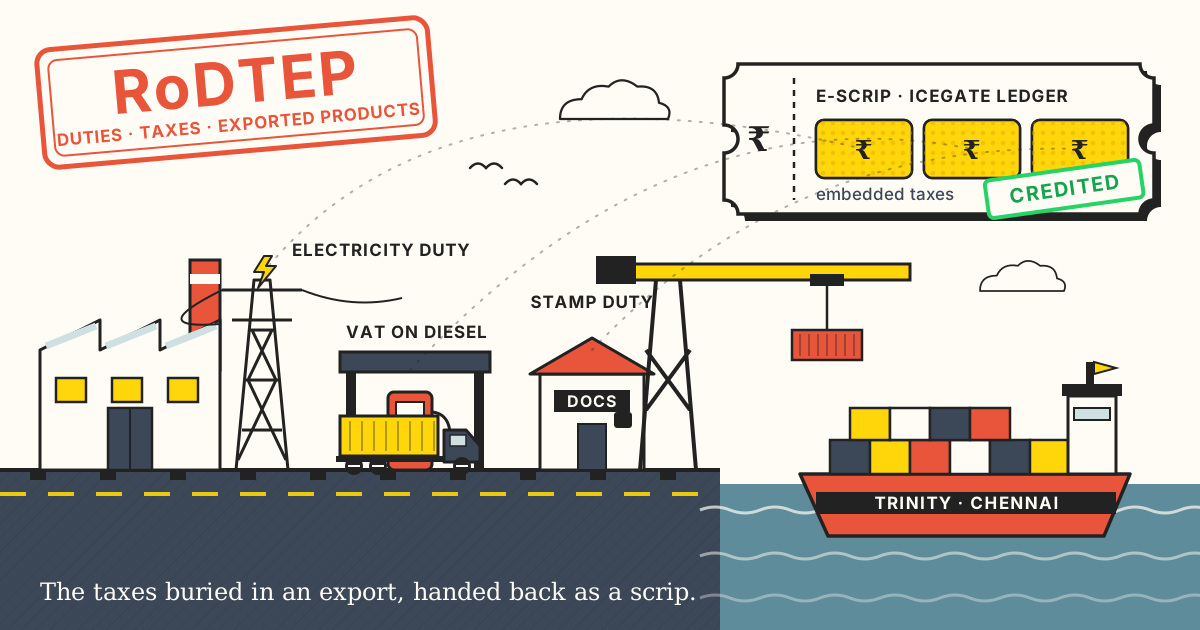
RoDTEP stands for Remission of Duties and Taxes on Exported Products. It pays exporters back for taxes that end up inside the cost of an export and that no other scheme refunds: VAT on the diesel in the truck that took your cargo to the port, duty on the electricity your machines ran on, mandi tax, stamp duty on export paperwork. You can't take input credit for any of these, so they sit in your price. RoDTEP is meant to take them out again.
It is an odd refund in a few ways. It isn't paid in cash. It arrives as an e-scrip, a duty credit in your ledger on ICEGATE, which you can use against basic customs duty on your own imports or sell to someone who can. You don't apply for it. It is one flag against each item in the shipping bill, and if the flag is missing when the shipping bill goes in, the benefit for that item is almost always gone. And it has never had a long horizon: in 2026 alone the rates were halved, restored, and the scheme extended twice.
This guide covers what RoDTEP pays back, where the scheme stands in October 2026, how the rates and caps work with real lines from the schedule, what happens between the shipping bill and the scrip, how to use or sell scrips, who is left out, and the mistakes we see most at Chennai. If you want RoDTEP set against duty drawback and the IGST refund, our duty drawback guide has that comparison, so it isn't repeated here.
What RoDTEP pays back
The Foreign Trade Policy gives the scheme two jobs. It refunds duties, taxes and levies at the central, state and local level that are borne on the exported product, including earlier-stage indirect taxes on the goods and services used to make it. It also covers the indirect taxes on distributing the product. And it won't refund anything that has already been exempted, remitted or credited somewhere else (FTP 2023, para 4.54).
That last rule is why RoDTEP is small and specific. GST on your inputs comes back through input tax credit or the IGST refund. Customs duty on imported inputs comes back through drawback. What's left over is tax that nobody gives credit for. When the Cabinet approved the scheme in March 2020, the examples it gave were VAT on fuel used in transport, mandi tax and duty on electricity used in manufacturing (PIB). The annual return DGFT now asks larger claimants to file adds stamp duty on export documents, VAT on fuel for captive power and the GST buried in purchases from unregistered dealers (Public Notice 27/2024-25).
RoDTEP applies to exports from 1 January 2021, when products began moving over to it from the old MEIS (Merchandise Exports from India Scheme). It is paid on top of drawback, and both can sit on the same item of the same shipping bill.
Where the scheme stands in October 2026
As of today, RoDTEP is notified only until 31 December 2026. DGFT's Notification 41/2026-27, issued on 30 September, continued it for exports by DTA units, Advance Authorisation holders, SEZ units and EOUs, with the rates and caps that applied on 30 September left unchanged.
Short extensions are normal for this scheme. Here is how it got to this point:
| Date | What happened |
|---|---|
| 1 Jan 2021 | Scheme starts for exports. No rates yet, but the claim has to be made in the shipping bill |
| 17 Aug 2021 | First rates notified in Appendix 4R |
| 15 Dec 2022 | Chemicals, pharma and iron and steel articles added |
| 11 Mar 2024 | Exports by Advance Authorisation holders and EOUs added, at Appendix 4RE rates |
| 1 Jul 2024 | Exports by SEZ units added |
| 10 Oct 2024 | Current Appendix 4R and 4RE schedules take effect |
| 6 Feb 2025 | Cover for AA, EOU and SEZ exports lapses. DGFT confirms the cut-off only on 20 March |
| 1 Jun 2025 | AA, EOU and SEZ cover restored |
| 30 Sep 2025 | Scheme extended to 31 March 2026, "subject to the budgetary framework" |
| 23 Feb 2026 | All rates and caps cut to 50% with immediate effect. A day later, chapters 1 to 24 are spared |
| 23 Mar 2026 | Full rates restored, from that date only |
| 31 Mar 2026 | Extended to 30 September 2026 |
| 30 Sep 2026 | Extended to 31 December 2026 |
Most rows come from DGFT notifications: 19/2015-20 for the first rates, 70/2023 for Appendix 4RE, 32/2024-25 for the October 2024 schedules, 66/2024-25 and 11/2025-26 for the lapse and the restoration, 35/2025-26, 60/2025-26 with its corrigendum, 66/2025-26 with its corrigendum, 74/2025-26 and 41/2026-27. The December 2022 row is from a PIB release, and the SEZ start date from CBIC Notification 50/2024-Customs (N.T.).
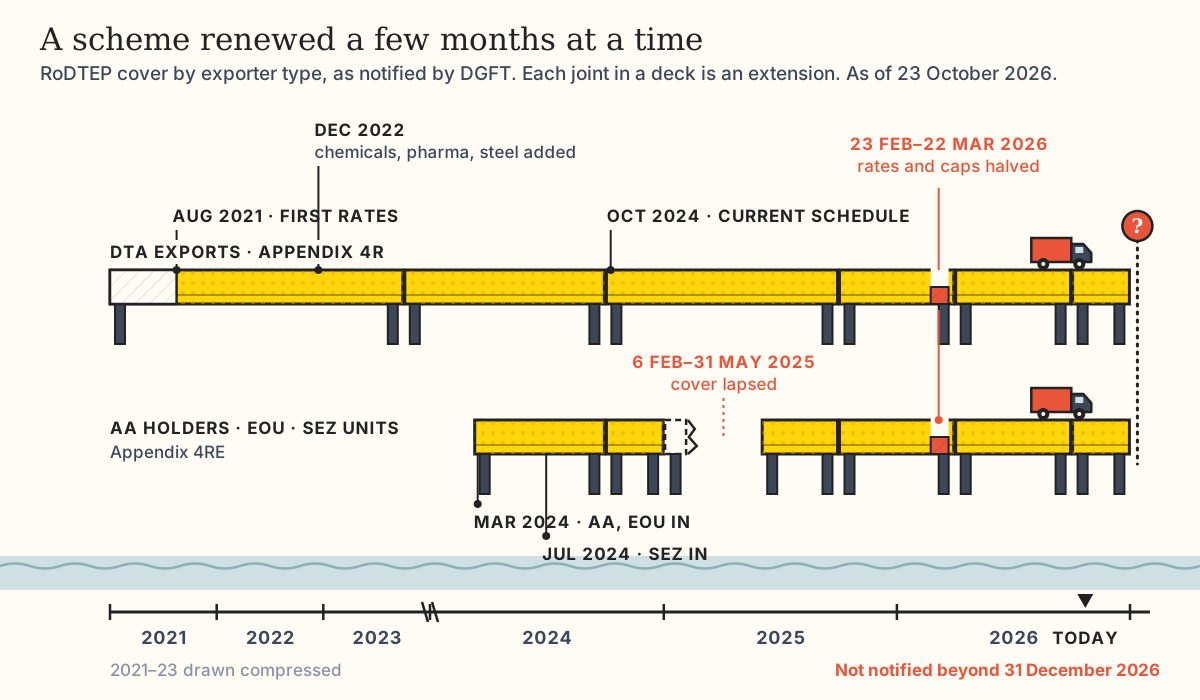
The 50% month matters if you shipped during it. The restoration in March was corrected the same day to run from 23 March, not back to 23 February, so exports in between stayed at half the rate and half the cap, except for chapters 1 to 24. The press release tied the restoration to freight disruption in West Asia (PIB). Neither notification gave a reason for the cut.
What happens after December is open. The budget papers for 2026-27 provide ₹10,000 crore for RoDTEP, against ₹18,232.50 crore in the revised estimate for 2025-26, and say the government proposes to fold RoDTEP and RoSCTL into the Export Promotion Mission "after appraisal and approval" (Notes on Demands for Grants 2026-27). The policy itself says the scheme runs inside a yearly budget and that benefits will be recalibrated to stay within it. February showed what that looks like.
So our advice is plain. Don't price orders shipping in 2027 as if RoDTEP will be there at today's rates. Quote on the product, treat RoDTEP as a bonus that may or may not exist on your shipping date, and if you do count on it, check DGFT's notifications in the week the shipping bill is filed, not the week you quoted.
How the rate and the cap work
RoDTEP rates are set per 8-digit tariff line, in two schedules. Appendix 4R covers normal (DTA) exports. Appendix 4RE covers exports by Advance Authorisation holders (other than deemed exports), EOUs and SEZ units. Each line has a unit (the UQC), a rate as a percentage of FOB value, and on many lines a cap in rupees per unit. You get the rate applied to FOB, but never more than the cap times the quantity.
Two details sit underneath that. The value the rate is applied to is the declared FOB value or 1.5 times the market price of the goods, whichever is lower (CBIC Notification 24/2023-Customs (N.T.)). And the policy allows some items to get a fixed rupee amount per unit instead of a percentage.
The rates are low. In the current Appendix 4R, in force since 10 October 2024, they run from 0.01% to 3.9%, and about three lines in four are at 1% or less. That's our count from the schedule, not an official figure. Appendix 4RE rates for the same line are usually lower.
Two real lines, worked through
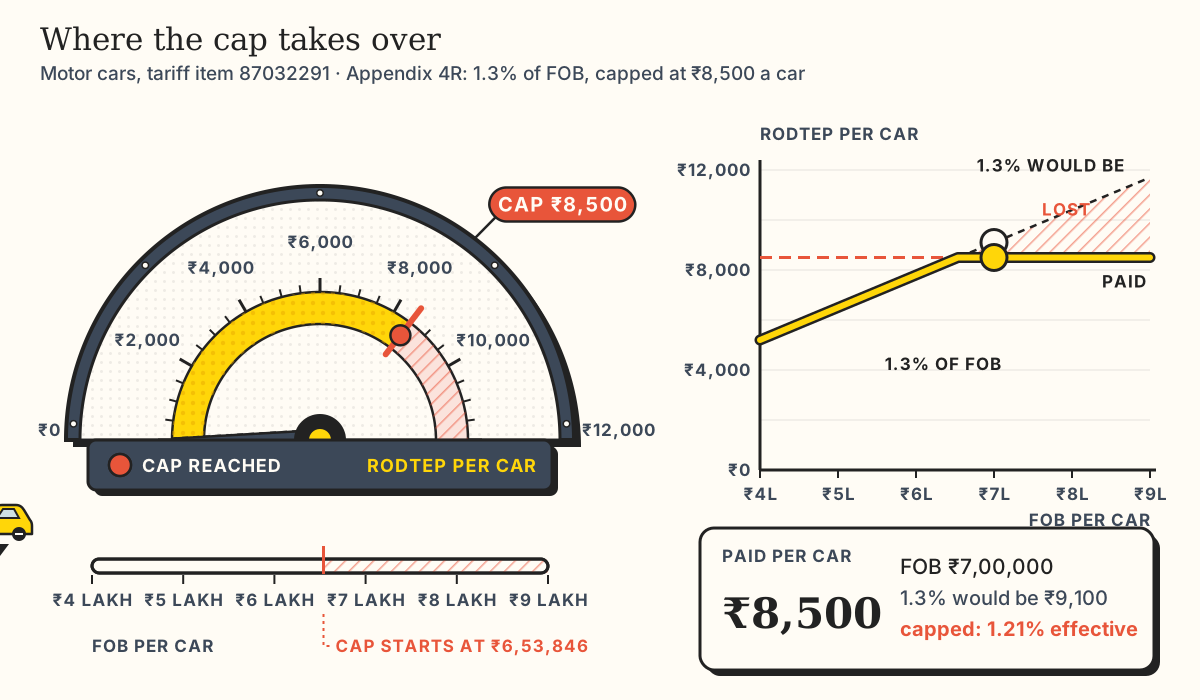
Cars. Tariff item 87032291 covers petrol (spark-ignition) cars between 1,000 cc and 1,500 cc. Appendix 4R gives it 1.3% of FOB, capped at ₹8,500 per car.
- At FOB ₹5,20,000 a car: 1.3% is ₹6,760, under the cap. A shipment of 400 cars earns ₹27,04,000.
- At FOB ₹7,00,000 a car: 1.3% would be ₹9,100, so the cap stops it at ₹8,500. The same 400 cars earn ₹34,00,000, an effective rate of 1.21%.
The cap starts to bite at ₹6,53,846 a car. Above that, a higher price earns nothing extra. If the cars are made under an Advance Authorisation, Appendix 4RE applies instead: 0.8%, capped at ₹5,100. And for cars shipped between 23 February and 22 March 2026, the numbers were 0.65% and ₹4,250.
Cotton yarn. Tariff item 52052410 is grey single cotton yarn of combed fibres, 52 to 80 metric count. It carries 3.4% of FOB, capped at ₹10 a kilogram. Take a spinning mill near Coimbatore shipping 20 tonnes:
- At ₹260 a kg: 3.4% is ₹8.84 a kg, under the cap. RoDTEP on the shipment: ₹1,76,800.
- At ₹320 a kg: 3.4% would be ₹10.88, so it's capped at ₹10. RoDTEP: ₹2,00,000 instead of ₹2,17,600.
Here the cap starts at ₹294.12 a kg. Under Appendix 4RE the same yarn gets 2%, capped at ₹6 a kg.
The unit is part of the cap
Caps are per UQC, and the shipping bill has to carry the quantity in the line's statistical UQC. The yarn above is capped per kilogram. If the quantity goes in as 20, meaning tonnes, instead of 20,000 kilograms, the cap is worked out on 20 kg and your RoDTEP on a 20-tonne shipment comes to ₹200. It's the same trap as the per-piece caps in drawback, and it's caught only if someone reads the checklist before the shipping bill is submitted.
Garments are not in RoDTEP
If you make T-shirts in Tiruppur, this schedule isn't yours. Chapters 61, 62 and 63 (apparel and made-ups) get RoSCTL, the Rebate of State and Central Taxes and Levies, instead of RoDTEP (ICEGATE e-scrip advisory). RoSCTL is paid into the same e-scrip ledger, and the Ministry of Textiles has also extended it to 31 December 2026 (PIB).
Claiming it in the shipping bill
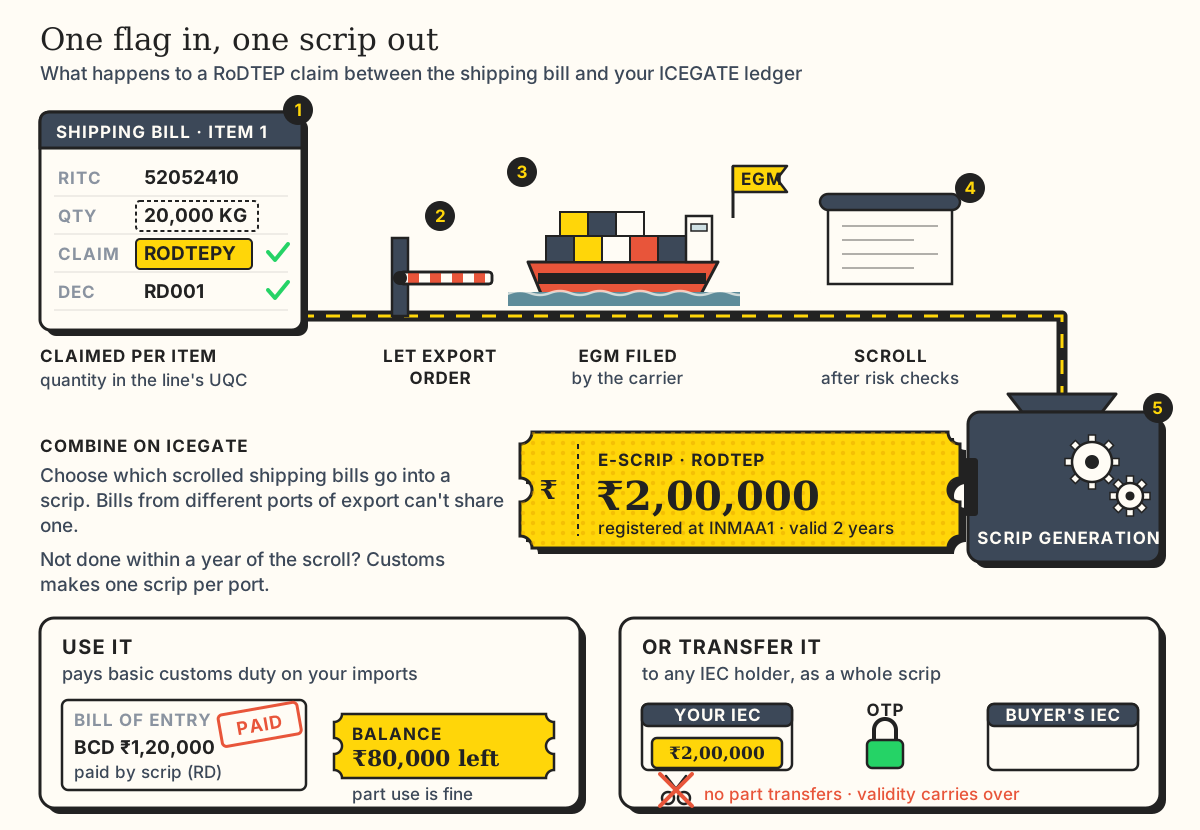
There is no RoDTEP application form. The claim is made item by item inside the shipping bill, which your customs broker files with the rest of the export data. For each item you want RoDTEP on, the shipping bill carries three things (ICEGATE Advisory 01/2021):
- the claim code RODTEPY (RODTEPN means you're not claiming);
- the quantity in the item's statistical UQC;
- a declaration under statement code RD001, confirming you meet the scheme's conditions.
If an item doesn't carry RODTEPY, nothing accrues on it. The system works out the amount from the notified rate once the claim is in. You don't need an RCMC for any of this. DGFT clarified in October 2024 that the RCMC requirement doesn't apply to remission schemes like RoDTEP, RoSCTL and drawback (Trade Notice 19/2024-25). Our RCMC guide covers when you do need one.
After the let export order, the claim waits for the EGM, the export manifest the carrier files once the cargo has left. Then customs' risk system either sends the shipping bill straight to the scroll queue or routes it to an officer. Cleared claims are paid out in scrolls. If drawback on an exporter or a shipping bill is suspended, RoDTEP scrolls for it stop too.
At Chennai, the EGM is where RoDTEP stalls most often. Almost all of Chennai's container freight stations are mapped to Chennai port (INMAA1), so cargo bound for Kamarajar (Ennore) or Kattupalli moves under a transshipment module. When that movement isn't updated online in time, the destination port can't record the shipment as allowed for shipment, and the result is an EGM error and a stuck incentive. The customs brokers' association raised exactly this at the Export Commissionerate's facilitation meeting in July 2026 (minutes). If you ship through Ennore or Kattupalli, check the EGM on ICEGATE before you check anything else.
Can a missed claim be fixed later?
Rarely, and not quickly. The 2021 advisory allowed no changes to the claim after the EGM. Since 2025 customs has had an online module to amend shipping bills after export under section 149 (CBIC Circular 11/2025), and DG Systems noted that most requests it got were to switch RoDTEP from N to Y. When the module launched in March 2025, the Board allowed it only where a High Court had ordered the amendment (ICES Advisory 16/2025, circulated by Chennai Customs). Chennai Customs later opened it for one specific problem: tariff lines whose rates were notified retrospectively from 1 May 2025, which exporters couldn't have claimed at filing (Public Notice 48/2025). A plain oversight is a different matter, and it's up to the officer. Treat the flag as something you get right the first time.
From scroll to e-scrip
Once a scroll is generated, the credit appears against your IEC in ICEGATE's electronic duty credit ledger. It isn't a scrip yet. To make one (ICEGATE e-scrip advisory):
- Log in to ICEGATE as the IEC holder, or as a customs broker, registered with a digital signature certificate.
- Open the e-scrip credit ledger. The first time, add a ledger account for RoDTEP.
- Under Scrip Generation, select the scrolled shipping bills you want to combine.
- The system creates an e-scrip with a unique number and posts it to your ledger as a credit.
You can combine credit from many shipping bills into one scrip, but only from the same customs station of export. A Chennai sea shipment and a Bengaluru air shipment make two scrips. The station of export also becomes the scrip's station of registration. You have a year from the scroll to do this. After that, the system creates one scrip per station for you (Electronic Duty Credit Ledger Regulations, 2021, regulations 4 and 5).
A scrip is valid for two years from the day it's created. It was one year until September 2022 (Notification 79/2022-Customs (N.T.)), and plenty of guides still say one year. Credit left in a scrip at the end of two years lapses, and it can't be regenerated.
Using or selling the scrip
A RoDTEP scrip pays one thing: basic customs duty on imports (FTP para 4.56). It's debited in the bill of entry like a licence, under scheme code RD. The other duties on the import are paid the normal way.
You can use part of a scrip and keep the balance for the next import. You can't transfer part of one. A transfer moves the whole scrip to another IEC holder's ledger. The transferee has to accept it, both sides confirm with an OTP that is valid for 15 minutes, and the scrip's validity doesn't restart with the new owner (EDCL regulation 7).
That makes the decision fairly simple.
- If you import and pay BCD, use the scrips yourself. An exporter in Bengaluru who brings in components every month can set the credit straight off against duty.
- If you don't import, sell them. Buyers are importers who pay basic customs duty. The price is a discount to face value that you negotiate, and there's no official rate for it. Since September 2022 a buyer no longer inherits the risk of the exporter's RoDTEP being recovered (CBIC Circular 21/2022), which made scrips easier to sell.
- Size scrips for the buyer. Because a transfer is all or nothing, one huge scrip is harder to place than a few smaller ones. You choose which shipping bills go into each scrip when you generate it, so plan that with the sale in mind.
One change from this year: if duty you paid with a scrip is later refunded, for example as Section 74 drawback when imported goods go back out, it comes back as a re-credit in the ledger, not as cash (CBIC Circular 30/2026).
Who is left out
Para 4.55 of the FTP lists the exports that don't get RoDTEP:
- re-export of imported goods (FTP para 2.46), and goods trans-shipped through India;
- products subject to a minimum export price or an export duty;
- products restricted or prohibited for export under Schedule 2 of ITC (HS);
- deemed exports, and supplies from DTA units to SEZ or FTWZ units;
- products made partly or wholly in a customs bonded warehouse under section 65;
- products made or exported under Customs Notification 32/1997, the job-work exemption;
- exports without ICEGATE EDI documentation, or from non-EDI ports;
- goods that were used after they were made.
Three groups that used to be on that list are now in, through Appendix 4RE: Advance Authorisation holders (for physical exports, not deemed exports), EOUs and SEZ units. Their rates are lower. In the examples above, 4RE comes to about 60% of 4R, though some lines carry the same rate in both. Our guide to Advance Authorisation and EPCG explains how RoDTEP and drawback change when you export under an authorisation.
Courier and post are covered too. Courier exports can claim RoDTEP through the customs EDI system at international courier terminals (CBIC Circular 15/2024), and postal exports have been able to since 15 January 2026 (CBIC Circular 01/2026).
When RoDTEP has to be paid back
Like drawback, RoDTEP is paid before your buyer pays you, on the condition that the money arrives. If export proceeds aren't realised within the time FEMA allows, the policy treats the rebate as never allowed. That period is nine months from shipment for most goods exports as of October 2026 (FEMA 23(R)/2026-RB, as amended). Customs' rules then require you to repay the credit with interest within 15 days of the period ending, in proportion if only part of the money came in (CBIC Notification 24/2023-Customs (N.T.), para 5). The interest rate is the one fixed under section 28AA, 15% a year (Notification 33/2016-Customs (N.T.)). While proceeds on earlier exports are overdue, new credit can be held back.
The data behind this comes from your bank's realisation reporting. A payment that arrived but was never linked to the right shipping bill looks the same as one that never arrived, so make sure your bank is reporting realisation against each shipping bill.
The annual return. If your RoDTEP claims across all tariff lines come to more than ₹1 crore in a financial year, you must file an Annual RoDTEP Return on the DGFT portal by 31 March of the next year (HBP para 4.94). If you don't, scrolls at the port stop after a three-month grace period until you file and pay a composition fee of ₹10,000 up to 30 June and ₹20,000 after that. Keep the records behind the return for five years. DGFT can scrutinise returns and ask for excess claims back.
Mistakes that cost exporters money
These are the ones we see at the port, roughly in order of how often they happen.
The flag isn't on the item. RODTEPN instead of RODTEPY, or the RD001 declaration missing. It's one field in a long checklist, and it's the expensive one. Read the checklist before your broker submits it, every time.
The quantity is in the wrong unit. Caps are per UQC. Kilograms declared as tonnes, or sets declared as pieces, and the cap is worked out on the wrong number.
The tariff line is wrong. The rate follows the 8-digit line, and changing the HS code on a shipping bill after export needs an Additional or Joint Commissioner's approval. Classify for the schedule before filing, the way you would for drawback. Our HS code guide explains how the 8-digit line is chosen.
The EGM doesn't tie. No EGM, no scroll. At Chennai that includes the transshipment movements to Ennore and Kattupalli. Check that the EGM is in before you go looking for the scroll.
Nobody generates the scrips. The credit sits in the ledger, the system eventually creates scrips by itself after a year, and the two-year clock starts. Then somebody finds a scrip that expired.
The rate on the day isn't the rate you remember. Shipments between 23 February and 22 March 2026 got half. RoDTEP follows the notification in force for your shipment, not your costing sheet.
The buyer pays late. RoDTEP is provisional until the money is realised and linked to the shipping bill. A buyer who pays in month eleven can cost you the rebate plus interest.
A ₹1 crore claimant forgets the annual return. Scrolls stop once the grace period runs out.
Frequently asked questions
What is the full form of RoDTEP?
Remission of Duties and Taxes on Exported Products. It refunds embedded central, state and local taxes that no other scheme refunds, as a duty credit e-scrip.
Is RoDTEP available after 31 December 2026?
Not as of 23 October 2026. It's notified until 31 December. The 2026-27 budget provision is lower than the last two years, and the government has proposed folding RoDTEP into the Export Promotion Mission. Watch DGFT's notifications in late December.
How is the RoDTEP amount calculated?
Take the rate for your 8-digit line in Appendix 4R (or 4RE if you export under an Advance Authorisation, as an EOU or from an SEZ). Apply it to the FOB value, or to 1.5 times the market price if that is lower. Then compare with the cap per unit times the quantity in the line's UQC. You get the smaller of the two.
Do I need to apply for RoDTEP separately?
No. It's claimed item by item in the shipping bill with RODTEPY and the RD001 declaration. After the EGM and the scroll, you generate scrips on ICEGATE.
How long is a RoDTEP scrip valid?
Two years from the date the scrip is created. Unused credit lapses after that and can't be regenerated.
Can I sell RoDTEP scrips?
Yes, to any IEC holder, through ICEGATE. You have to transfer the whole scrip, and its validity doesn't restart for the buyer.
Can a RoDTEP scrip pay IGST?
No. It pays basic customs duty only.
Can I claim RoDTEP and drawback on the same shipment?
Yes. They refund different taxes, and RoDTEP is allowed in addition to drawback on the same item.
The short version
RoDTEP gives back taxes that are buried in the cost of an export: fuel, electricity, stamp duty and the like. It pays a small percentage of FOB, capped per unit, as an e-scrip that covers basic customs duty or can be sold whole. It is claimed by one flag per item in the shipping bill, and it is notified only until 31 December 2026, with a smaller budget behind it for next year.
The money is easy to lose: a missing flag, a wrong unit, an EGM that doesn't tie, a scrip that expires, a buyer who pays late. Each of those is a two-minute check done at the right time.
Trinity Freight Services handles export clearance from Chennai and Bengaluru. We declare RoDTEP and drawback on every eligible item, check the quantity against the unit the cap is measured in, and follow the EGM and scroll until the credit is in your ledger. If you have RoDTEP scrolls stuck at Chennai, or you're not sure whether your products fall under Appendix 4R or 4RE, talk to us.