
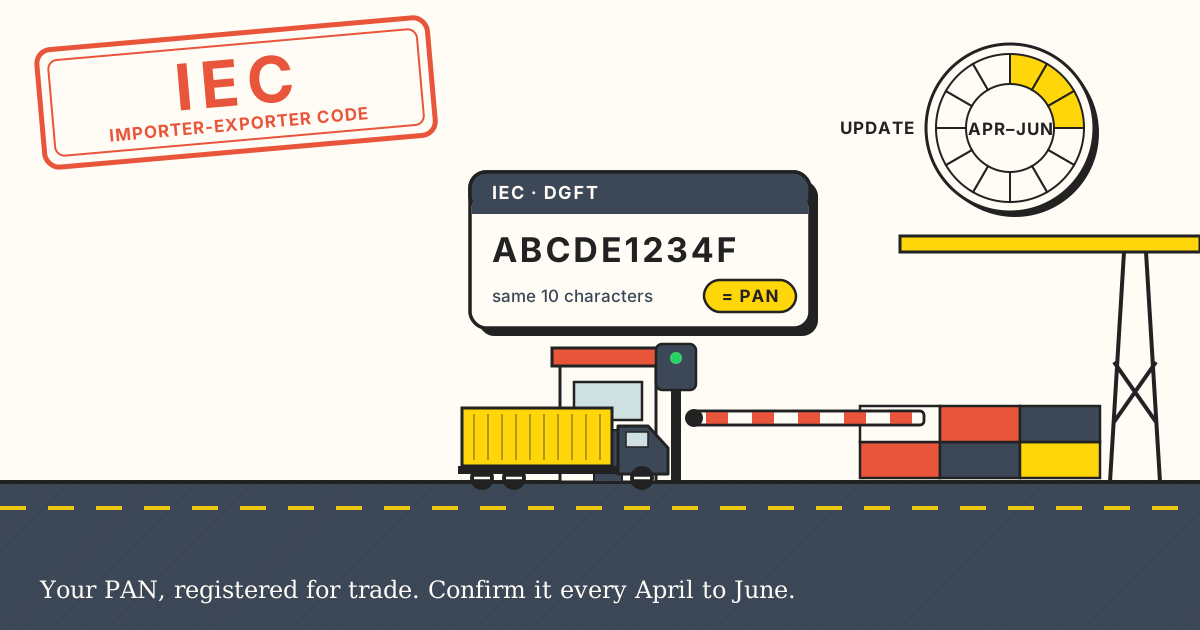
IEC stands for Importer-Exporter Code. It's the 10-character code DGFT gives every business that imports or exports goods, and it's the same as the business's PAN. The Foreign Trade (Development and Regulation) Act says nobody may import or export except under an IEC, and customs systems recognise only IECs that DGFT has issued and passed on to them. No IEC, no bill of entry and no shipping bill.
Getting one is cheap and mostly automatic: an online form, ₹500, and a code that's often generated the same day. Keeping it active is the part people forget. Since 2021 every IEC has to be updated, or confirmed unchanged, online between April and June each year. An IEC that isn't gets de-activated, and DGFT passes that status on to customs.
This guide covers what an IEC is and who's exempt, how to apply on the DGFT portal as it works in October 2026, the annual update, how to check any IEC, what the different statuses mean, and how to change your details.
What an IEC is
The full form is Importer-Exporter Code, and the Act calls it the Importer-exporter Code Number. The Foreign Trade Policy puts it simply: no export or import of goods without an IEC unless you're specifically exempted (FTP 2023, para 2.05). A few things follow from the rules:
- It's your PAN. The IEC is the same as the entity's Permanent Account Number, but DGFT still issues it separately, on an online application.
- One per PAN. You can't hold two IECs on the same PAN (HBP para 2.12). Branches, factories and units all go under the one IEC, each with its own GSTIN.
- It doesn't expire. An IEC has permanent validity unless it's suspended or cancelled. It does have to be updated every year, or it's de-activated.
- Services are different. For exports of services or technology, an IEC is needed only if you want to claim benefits under the Foreign Trade Policy.
Who needs one, and who doesn't
Any business importing or exporting goods needs an IEC. The Handbook of Procedures exempts a few groups (HBP para 2.07):
- Central and State Government ministries and departments;
- people importing or exporting for personal use, not connected with trade, manufacture or agriculture;
- cases covered by the 1993 exemption order, such as baggage and certain personal imports;
- small border trade with Nepal, Bhutan, Myanmar and China, within per-consignment value limits.
Exempted categories file under permanent IEC numbers set out in the Handbook. A few of them:
| Who | Permanent IEC |
|---|---|
| Central Government ministries and departments | AMDCG0111E |
| State Government departments | ADSGA0129E |
| Diplomats and UN officials | DCUNO0137E |
| Travellers claiming under the Baggage Rules | IABBR0145E |
| Imports and exports for personal use | IIHIE0153E |
| ATA carnet and exhibition goods | ATAEF1096E |
| Duty-exempt relief goods for natural calamities | ICIRN1126E |
If you're shipping commercially, none of these is for you. A business that "just wants to try one export" still needs its own IEC.
How to apply on DGFT
You apply online in form ANF-2A on dgft.gov.in. Nothing is filed on paper. DGFT's home page warns that look-alike websites charge people for IEC certificates, so check the address before you pay anyone.
- Register on the portal as an Importer/Exporter, using an email address and mobile number. Both are verified by OTP.
- Start "Apply for IEC" from your dashboard and fill in ANF-2A. Your PAN, name and date of birth are checked against Income Tax records. For a company, the CIN and directors are pulled from the MCA.
- Declare every bank account linked to your PAN. Since February 2026, DGFT validates bank details through NPCI, and the PAN, name and account details have to match the bank's records (Trade Notice 23/2025-26).
- Upload the documents, as PDFs of up to 5 MB each:
- a cancelled cheque with the entity's name pre-printed, or a bank certificate in DGFT's format. The certificate is on bank letterhead, signed by a manager or above, and carries your photograph, a photograph of the business premises and the premises' geo-tagged location (Public Notice 32/2025-26);
- address proof: a sale deed, rent or lease deed, electricity bill, landline or post-paid mobile bill, MoU or partnership deed, with the owner's NOC if the premises aren't in the firm's name;
- proof of establishment, if you're a partnership, trust, society or HUF.
- Sign with a digital signature or Aadhaar e-sign. A DSC isn't compulsory.
- Pay ₹500 online through Bharatkosh (Appendix 2K).
The IEC is generated automatically, and you're told by email and SMS. The one thing that slows it down is the bank check. If NPCI's validation is still in progress, the application waits under automatic review, and DGFT's own manual says this can take up to two weeks for some banks (IEC user manual). If the validation fails, a new application is rejected. Once issued, you can print the e-IEC certificate from the portal, and DGFT transmits the IEC to customs. The portal shows a "CBIC transmission status", and it's worth checking before your first shipment.
What holds applications up
Since DGFT began checking applications against bank, tax and company records, these are the mismatches that hold them up:
- The bank account doesn't match. The account holder's name has to be the firm's name, and the PAN, name and account details have to agree with what the bank holds. NPCI checks this, and a mismatch stops the application.
- An account wasn't declared. DGFT now asks for every active bank account linked to the PAN, including ones you never use for exports.
- The firm name was typed in. Only proprietorships can enter the firm name themselves. For companies it comes from MCA records, and for partnerships, LLPs, HUFs, trusts and societies it's the name as per PAN.
- The premises aren't yours. If the address proof is in someone else's name, the owner's NOC has to be in the same PDF. Aadhaar, a passport or a voter ID count as address proof only for proprietorships.
Since a new IEC only takes a short form and ₹500 when your documents are ready, there's little reason to pay anyone a large fee to "register" one. What's worth paying for is getting the details right the first time, because the same IEC, address and bank account flow into customs, drawback and IGST refunds later.
The annual update
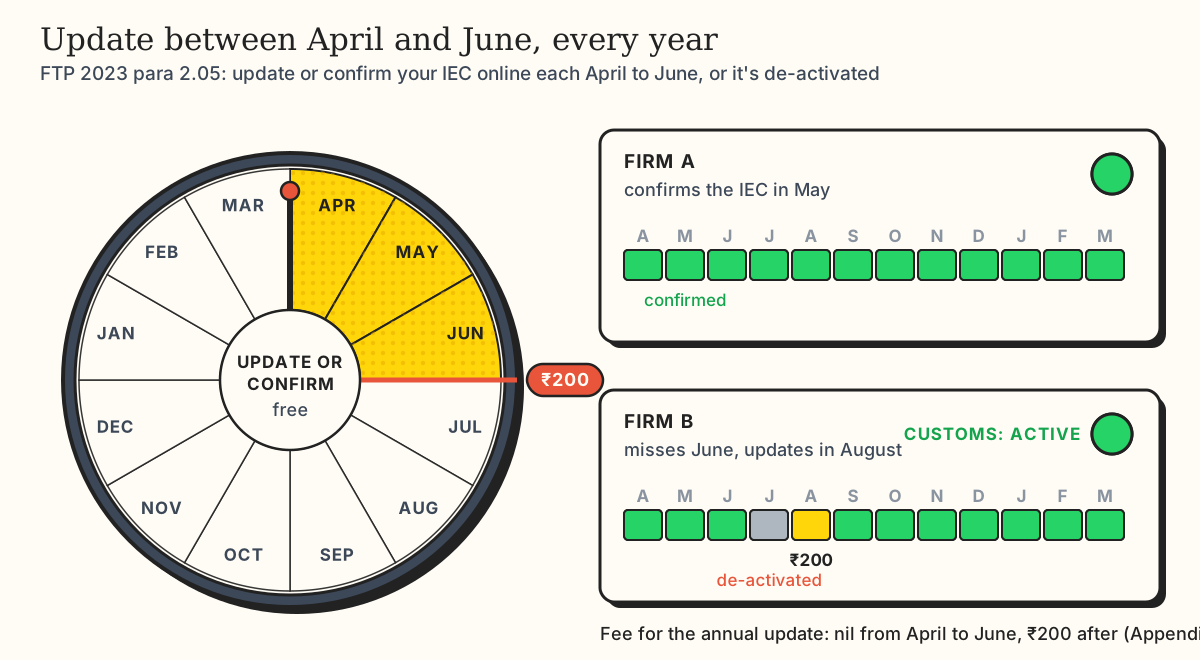
This is the rule that catches people. Every IEC holder has to update the IEC's details online every year during April, May and June. If nothing has changed, you still have to log in and confirm that it hasn't. An IEC that isn't updated in time is de-activated, and it's activated again once it's updated successfully (FTP para 2.05(d) and (e)).
- It's free in the window. The update costs nothing from April to June and ₹200 after that (Appendix 2K).
- It's in addition to the 30-day rule. If your constitution, address, bank account or other primary details change during the year, you have to update the IEC within 30 days of the change (HBP para 2.14(b)).
- De-activation happens in drives. The annual update came in through Notification 58/2015-20 in February 2021, and DGFT then de-activated IECs in phases: first those not updated since 2005 (Trade Notice 18/2021-22), then those not updated since 2014 (Trade Notice 25/2021-22). DGFT hasn't published a fixed date after June for it, so don't count on a grace period.
- Re-activation is online. Update the IEC, and it's re-activated and the new status is sent to customs. You don't need to visit a DGFT office.
Put it in the calendar every April with your LUT renewal, which falls due at the same time. Our export documents guide covers the LUT and the other registrations to check each year.
Where the IEC goes next
An IEC on its own doesn't get a shipment through. Once you have one:
- Register on ICEGATE with it, so your documents can be filed and tracked against your IEC.
- Register your AD code and your refund bank account on ICEGATE. The AD code needs registering once. The refund account is registered per customs location, which ICEGATE now lets you do for all locations in one go. Our AD code registration guide walks through both.
- Map your IEC to your GSTIN on ICEGATE.
- Get an RCMC if you plan to apply for an Advance Authorisation or EPCG. Our RCMC guide explains which council to join.
Keep the bank account on your IEC current. DGFT shares the IEC's primary bank account with customs, so an old account on the IEC causes trouble well beyond the DGFT portal.
How to check or verify an IEC
DGFT has a public lookup that doesn't need a login. Go to Services, then "View IEC Related Details", then "View Any IEC". Enter the IEC, the first three characters of the firm's name and the captcha. It returns the firm's basic IEC details, including:
- the IEC and PAN, and the date of issue;
- the IEC status, for example valid, or the dates it was suspended or cancelled;
- the DEL status, which tells you whether the firm is on DGFT's Denied Entity List;
- the firm's name, address, nature of concern and the DGFT office it falls under.
Use it on your own IEC after the annual update, and on any new party you're dealing with. A merchant exporter buying from a new supplier, or a manufacturer about to ship for an exporter whose name they've only seen on a purchase order, can check in a minute that the IEC is real and active. Your customs broker has to do the same before working for you: the broker licensing rules require brokers to verify a client's IEC and GSTIN.
On the customs side, ICEGATE doesn't offer a public IEC status check. It has a registration verification tool that shows whether a PAN is registered on ICEGATE and in what role (ICEGATE advisory), and an IEC-GSTIN mapping service that links your IEC to your GSTIN in customs (ICEGATE advisory).
De-activated, suspended, cancelled or on the DEL
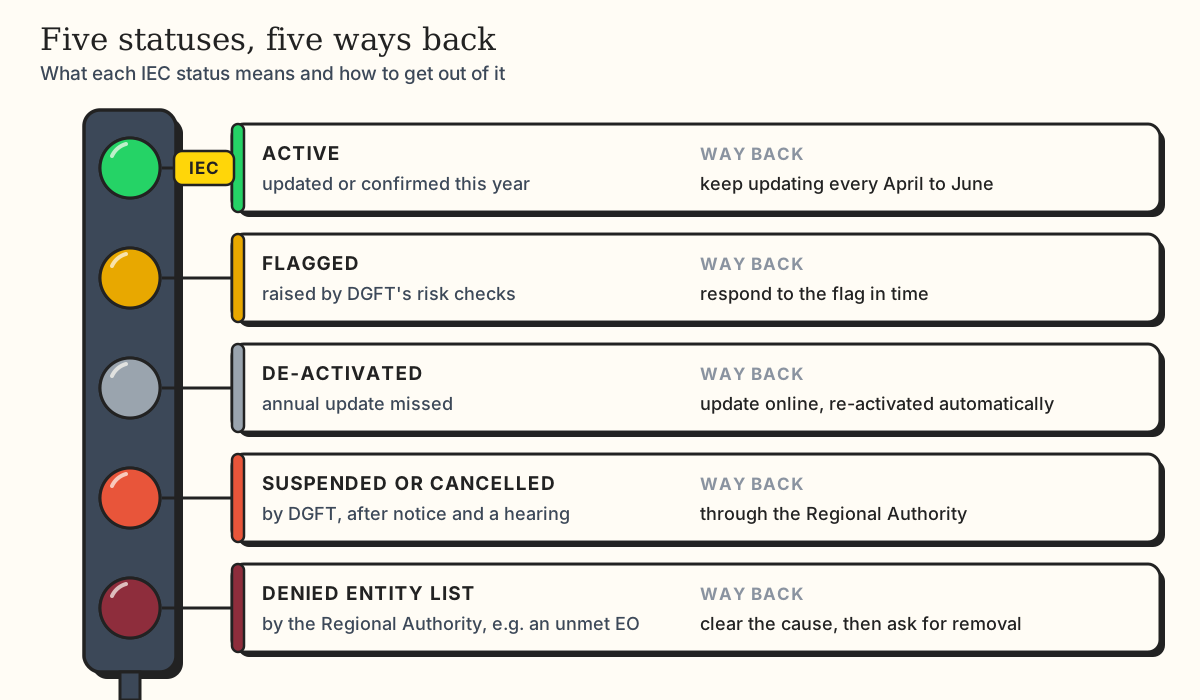
These words get used as if they mean the same thing. They don't, and the fix is different for each.
| Status | What it means | Who does it | How to get back |
|---|---|---|---|
| Flagged | The system has raised a risk on the IEC | DGFT's systems | Answer the flag. If you don't, the IEC is de-activated |
| De-activated | The IEC wasn't updated in time | DGFT, in drives | Update the IEC online. It's re-activated automatically |
| Suspended or cancelled | Action under section 8 of the Act, for example for breaking the Act, the policy, or customs or foreign exchange law | DGFT, after a written notice and a chance to be heard | Through the Regional Authority. A suspension can be revoked online, subject to approval |
| On the Denied Entity List (DEL) | Usually an unmet export obligation or an unpaid demand | The Regional Authority | Complete the obligation, pay the penalty or demand, then request removal online |
Some detail on the last two:
- Suspension and cancellation stop you importing or exporting at all, except under a special licence. An unpaid penalty can also get the IEC suspended until it's paid (FT(D&R) Act, sections 8 and 11, as amended in 2010). A surrendered IEC also shows as suspended.
- The DEL blocks every new licence, authorisation, scrip and certificate from DGFT, until you're off it (FTP para 2.14). Once the reason is cleared, you request removal on the portal, and the change can take up to 24 hours to show across DGFT's systems. If you hold an Advance Authorisation or EPCG, this is the status to worry about. Our guide to those schemes explains how an unmet export obligation leads there.
Changing your IEC details
Changes are made online through "Update/Modify IEC" on the portal, for ₹200 (Appendix 2K). Most go through automatically. A few go to the Regional Authority for approval: a change of PAN, of the nature of the concern, or of partners in a partnership, LLP, HUF, trust or society. You can't modify an IEC while it's suspended or cancelled.
Bank account changes go through the same NPCI check as new applications. If the check fails the first time, the request is marked deficient so you can correct it. If it fails again, it's rejected.
Two bigger events need more than an update. If a merger, acquisition, inheritance or transfer of business creates a new PAN, an IEC must be taken on the new PAN within 30 days (HBP para 2.14). And you can surrender an IEC online only after every authorisation and obligation against it is closed.
Frequently asked questions
What is the full form of IEC?
Importer-Exporter Code. It's the 10-character code, the same as your PAN, that DGFT issues for importing and exporting goods.
Is the IEC the same as PAN?
The characters are the same, but the IEC is a separate registration. You still have to apply for it on the DGFT portal.
How much does an IEC cost?
₹500 to apply. The annual update is free between April and June and costs ₹200 after that. Other modifications cost ₹200.
How long does it take to get an IEC?
The IEC is generated automatically once the application goes through. If the bank account check is still in progress, it can take up to about two weeks for some banks.
Does an IEC expire?
No. It has permanent validity unless suspended or cancelled. But it's de-activated if you don't update or confirm it online between April and June every year.
How do I check whether an IEC is active?
Use "View Any IEC" on the DGFT website with the IEC and the first three characters of the firm's name. It shows the IEC status and whether the firm is on the Denied Entity List.
Do I need an IEC to export services?
Only if you want to claim benefits under the Foreign Trade Policy for those services.
Can a business have more than one IEC?
No. Only one IEC is issued against a PAN. Branches and units are added to the same IEC.
The short version
An IEC is your PAN registered with DGFT for trade. It costs ₹500, it's applied for online, and it never expires. But every April to June it has to be updated or confirmed, or it's de-activated and customs is told. Check it on "View Any IEC" whenever you're unsure, keep the bank and address on it current, and if it's ever on the Denied Entity List, deal with the cause before anything else.
Trinity Freight Services clears imports and exports at Chennai and Bengaluru, and we check your IEC, AD code and bank registrations before your first shipping bill goes in. If you're starting to export, see our export clearance service or talk to us.