
Duty drawback is a refund of the customs duty you paid on imported goods or imported inputs, once those goods (or the products made from them) leave India again. The idea behind it is old and simple: a country should export goods, not taxes. If the polyester yarn in your T-shirt paid basic customs duty when it landed at Chennai, that duty should not sit inside the price a buyer in Hamburg pays for the T-shirt.
In practice, drawback is one of the most ignored refunds in Indian export. Not because it is hard to claim. It is claimed in the shipping bill itself, with no separate application for most exporters. It gets ignored because the amounts look small per piece, the rules are spread across a statute, a set of rules and a 150-page rate schedule, and the money arrives quietly into a bank account weeks after the cargo has sailed. Small per piece adds up over a year of shipments.
This guide covers the two kinds of drawback, how the All Industry Rate and its cap actually work, when you need a brand rate instead, how the payment flows, and the part most people learn too late: drawback can be taken back.
Two kinds of drawback, one name
People say "drawback" as if it is one scheme. The Customs Act actually has two, and they work very differently.
Section 74 covers imported goods that are re-exported. You imported something, paid duty on it, and now it is going back out. A machine that failed acceptance tests and is returning to the supplier. Exhibition stock that didn't sell. A wrong consignment. The goods themselves leave, and you get most of the duty you paid on them back.
Section 75 covers imported materials that were used to make something that is exported. Yarn becomes fabric becomes a shirt. Imported steel becomes a forged auto part. The goods that leave are not the goods that came in, so customs can't simply refund what you paid on a specific bill of entry. Instead, the government works out how much duty typically goes into making a product, and pays that back as a rate.
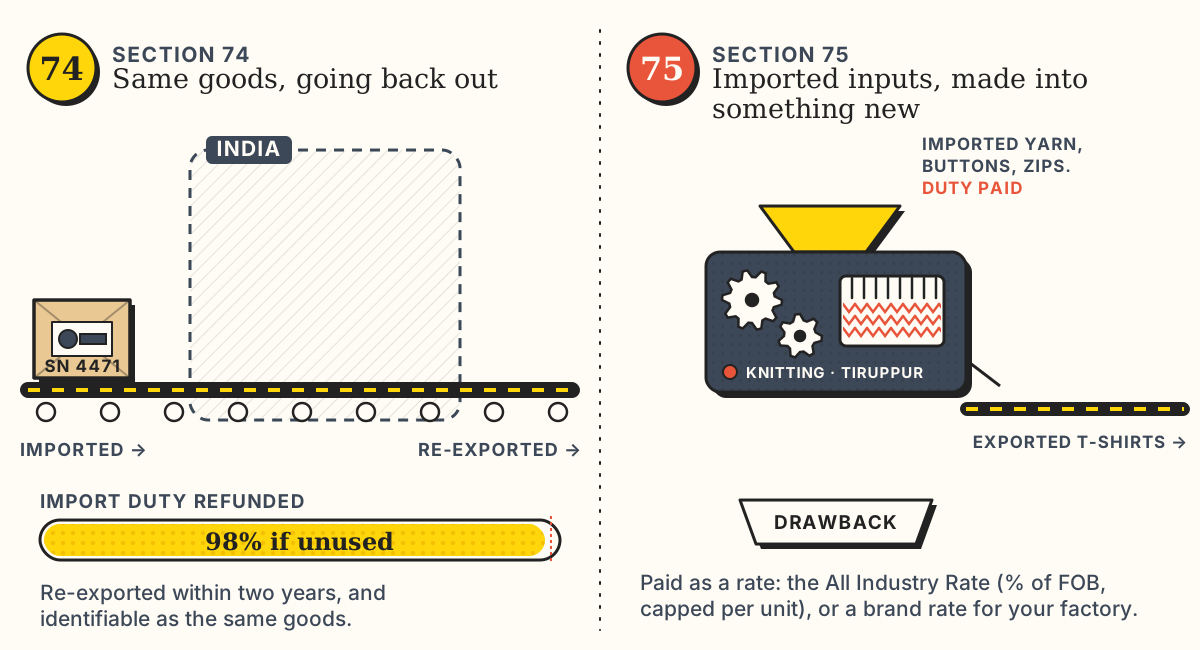
Most exporters live entirely in Section 75. If you manufacture and export, that is your drawback. Section 74 shows up occasionally, usually when something has gone wrong with an import, and it is worth knowing about precisely because those situations already cost money.
All Industry Rates and the cap
For Section 75, the default route is the All Industry Rate, usually shortened to AIR. A Drawback Committee studies what typical manufacturers in an industry pay in duties on their inputs, and the government notifies a rate for each product in a schedule. The current schedule is Notification 77/2023-Customs (N.T.), which took effect on 30 October 2023 and has been amended since, mostly for gold and silver jewellery.
Since GST arrived in 2017, these rates mainly reflect customs duty on imported inputs plus the central excise that still applies to fuel. Your GST is handled separately, through input tax credit or the IGST refund, so drawback is no longer the big number it was in the 2000s. It still matters. On thin export margins, 2% to 4% of FOB is often the difference between a decent order and a bad one.
Every entry in the schedule has four things you need to read together:
| Column | What it means | Example: cotton T-shirt |
|---|---|---|
| Tariff item | The drawback serial number you declare in the shipping bill | 610901 |
| Unit | What the cap is measured per | Piece |
| Rate | Percentage of FOB value (sometimes a fixed amount per unit) | 3.1% |
| Cap | The maximum drawback per unit, whatever the rate works out to | ₹12 |
The drawback tariff items line up with the customs tariff at the four-digit heading only. Below that, the schedule has its own breakdown. Cotton T-shirts sit under 610901, blends of cotton and man-made fibre under 610902, and so on. Picking the right serial is a classification exercise, not a lookup on your invoice HS code. If you have read our guide to HS codes, this is the same discipline, applied to a different list.
The cap is the part people miss
Here is where exporters get surprised. The rate is a percentage of FOB, but the cap is a fixed rupee figure per unit. So the more expensive your product, the less the percentage matters.
Take a knitwear exporter in Tiruppur shipping 20,000 cotton T-shirts through Chennai.
- At FOB ₹240 a piece: 3.1% works out to ₹7.44 per T-shirt. That is under the ₹12 cap, so the full rate applies. Drawback on the order: ₹1,48,800.
- At FOB ₹480 a piece: 3.1% would be ₹14.88 per T-shirt. The cap stops it at ₹12. Drawback on the order: ₹2,40,000, which is an effective rate of 2.5%, not 3.1%.
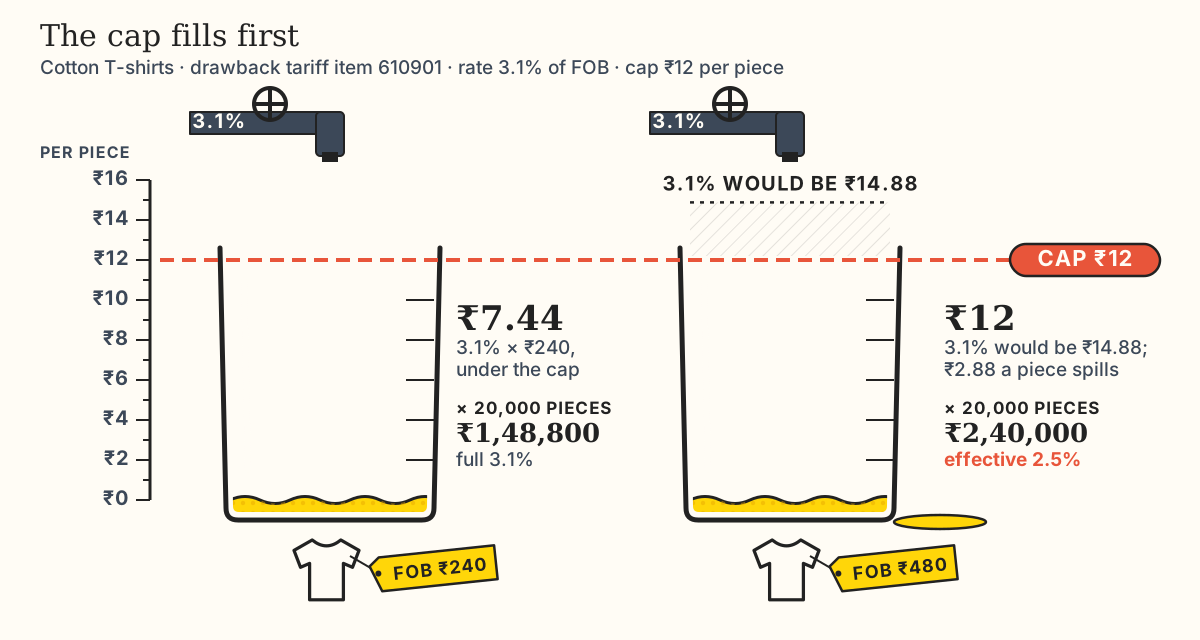
This is why premium exporters should always do the arithmetic per unit, not per invoice. If the cap is eating a big slice of what the rate would give you, it may be worth checking whether a brand rate makes sense. More on that below.
The unit also matters more than people expect. Some entries are capped per piece, some per kilogram, some per kilogram of a specific content (silk, silver). If your shipping bill declares the quantity in the wrong unit, the cap is calculated on the wrong base, and the claim either gets queried or paid wrong.
The small-amount rules
A few floors sit underneath all of this:
- Under Rule 8 of the Drawback Rules, 2017, no drawback rate is determined if it would be less than 1% of FOB value, unless the drawback on the shipment is more than ₹500.
- Section 76 of the Customs Act bars drawback below ₹50 on a claim, and where the market price of the goods is lower than the drawback itself. That second one exists to stop people exporting junk to collect refunds.
Where AIR doesn't apply at all
The notification lists cases where the schedule rates don't apply. The common ones:
- Goods made against an Advance Authorisation or DFIA, since you imported the inputs duty-free in the first place. (Special Advance Authorisation for garments has its own reduced table.)
- Goods made or exported by a 100% EOU, or a unit in an SEZ, FTZ or EPZ.
- Goods made in a customs bonded manufacturing warehouse under Section 65.
The logic is the same each time. Drawback refunds duty you paid. If a scheme already let you skip that duty, there is nothing to refund.
When the schedule doesn't fit: brand rates
The All Industry Rate is an average. Averages are fine until your factory isn't average. A brand rate is a drawback rate fixed for your product, based on the duties you actually paid on your inputs. There are two situations where you'd go for one.
There is no rate, or the rate is nil. Your product isn't in the schedule, or the schedule shows nil against it. Rule 6 of the Drawback Rules lets you apply for a rate to be fixed.
The rate is too low for you. Under Rule 7, if the AIR for your product is less than four-fifths of the duties you actually paid on the inputs, you can apply for a special brand rate. This tends to happen with products that use a high share of imported components, where the industry average assumes more local sourcing than you do.
Either way, the application needs to go in within three months of the let export order, with real data behind it: input-output ratios, the bills of entry for your imported inputs, invoices and duty payment proof. Customs can extend the deadline, but extensions cost a fee and are meant for genuine delays. Customs' own public notices complain about late applications, so don't count on leniency.
There is one trap worth knowing. If you claim the AIR in the shipping bill, you can't later apply for a Rule 7 brand rate on that same export. Decide which route you're taking before the shipping bill is filed. For most exporters AIR is simpler and good enough. Brand rates are worth the paperwork when the numbers are big and the gap is real.
Re-exporting imported goods under Section 74
Section 74 is the one people discover in a bad week. An imported machine fails installation. A buyer rejects a consignment. Equipment comes in for a project that gets cancelled. The goods are going back, and you've already paid the duty.
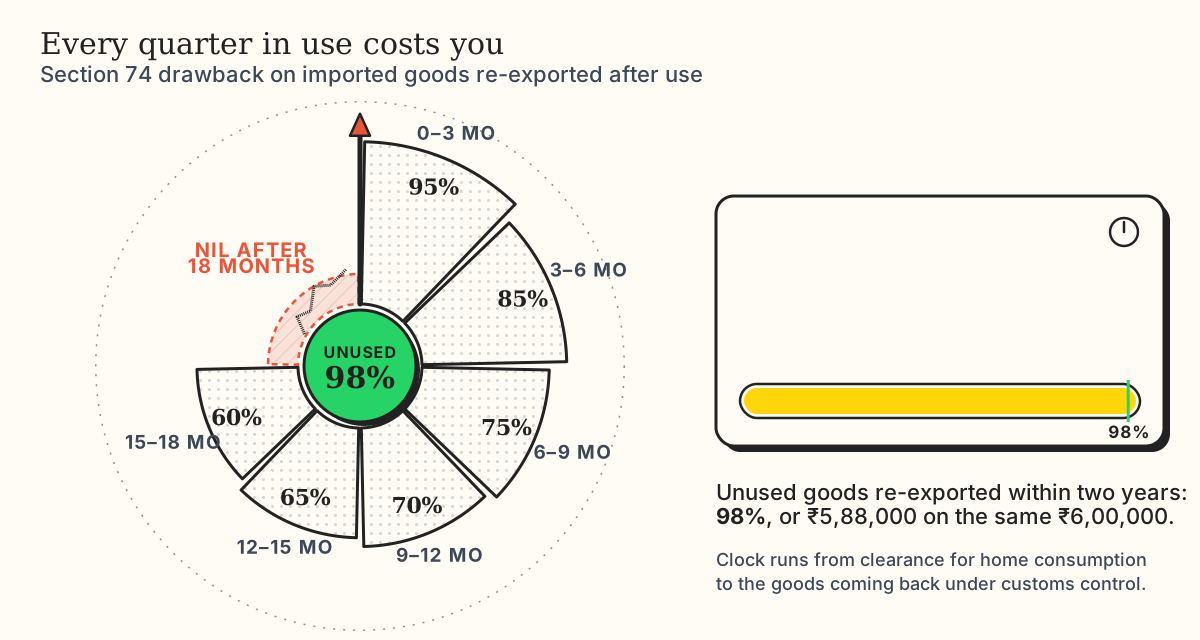
If the goods are re-exported without being used, you get 98% of the import duty back. The conditions under Section 74:
- The goods must be easily identifiable as the same goods you imported. Serial numbers, markings, the original packing, photos from arrival. Customs will examine them against the original bill of entry.
- They must be entered for export within two years of paying the import duty. The Board can extend this for sufficient cause, but don't plan around an extension.
If the goods were used in India, the refund drops depending on how long they were out of customs control. Under the current notification for used goods, it falls quarter by quarter and reaches nil after 18 months.
| Time between clearance and re-export | Drawback on used goods |
|---|---|
| Up to 3 months | 95% |
| 3 to 6 months | 85% |
| 6 to 9 months | 75% |
| 9 to 12 months | 70% |
| 12 to 15 months | 65% |
| 15 to 18 months | 60% |
| More than 18 months | Nil |
Say a Chennai auto component maker imported a CNC spindle and paid ₹6,00,000 in duty. It fails acceptance tests and goes back to Germany, uncrated and untouched. Drawback: ₹5,88,000. If it had been installed and run for five months before the problem showed up, the drawback would be 85%, or ₹5,10,000. At 20 months, nothing.
Two practical things. First, keep the evidence of identity from the day the goods arrive. It's very hard to prove a machine is "the same goods" a year later if nobody photographed the nameplate. Second, check the timing before you negotiate with the supplier. A replacement shipped quickly while the faulty unit sits in your factory for six more months can quietly cost you a big chunk of the refund.
How the claim gets paid
For AIR drawback there is no separate claim form. The shipping bill is the claim. Your customs broker declares the drawback serial number against each item, along with the declarations the rules require (that you haven't used Advance Authorisation, for example). Once customs gives the let export order, the shipping bill is treated as your drawback claim from that date.
After that, the money follows a fairly mechanical path:
- Shipping bill filed with the right drawback serial, unit and quantity for each item.
- Let export order (LEO) is given. The claim is now on record.
- Export General Manifest (EGM) is filed by the shipping line or airline once the cargo has actually left. No EGM, no proof of export, no drawback.
- Processing and scroll. The claim is processed in the customs system. If something doesn't match, it gets a query. Cleared claims are batched into a drawback scroll.
- Payment through PFMS into the bank account registered with customs against your IEC.
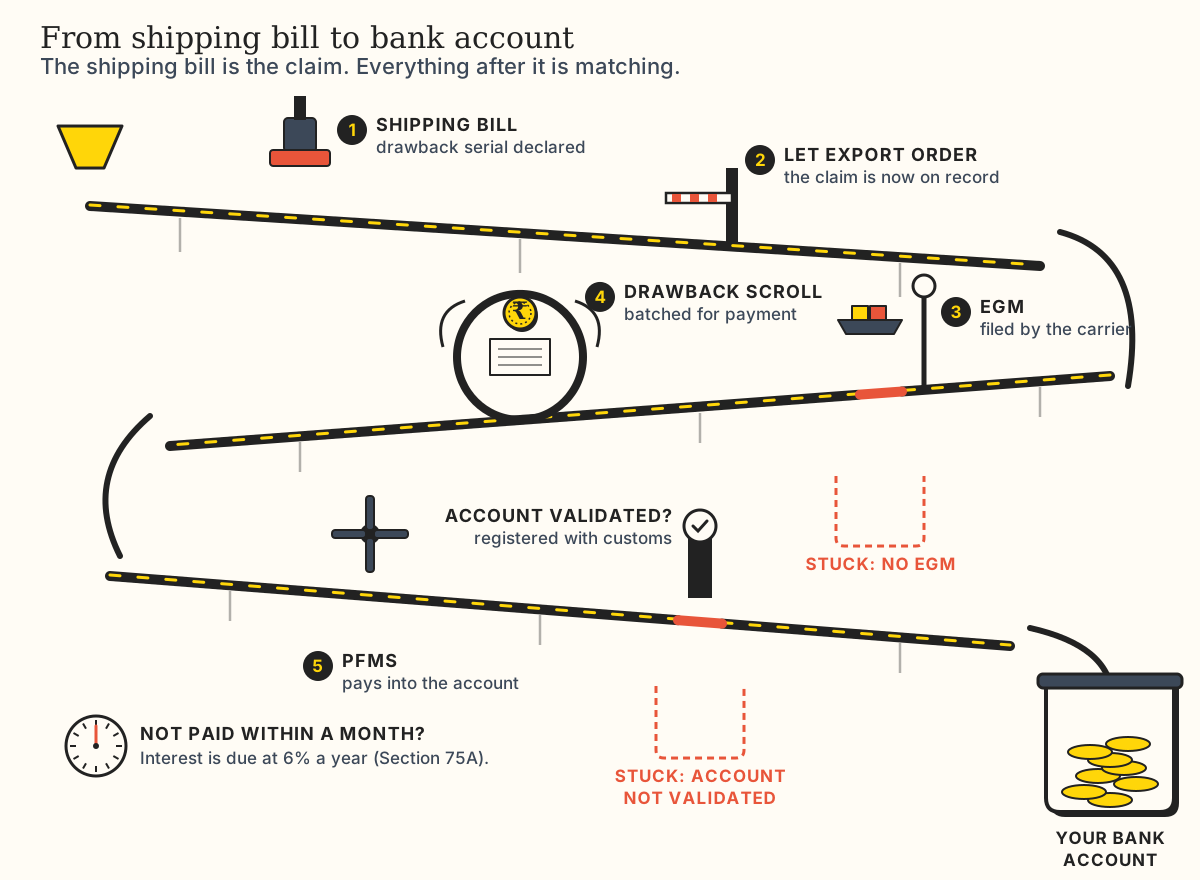
Section 75A of the Customs Act says that if drawback isn't paid within one month of the claim, interest is payable on top. The rate notified for this is 6% a year. That doesn't mean you should expect a cheque for interest. It means a claim pending for months is a sign that something in the chain is stuck, and it's worth finding out what.
You can track drawback status on ICEGATE against the shipping bill. If you're shipping regularly, have someone check it on a schedule. Ideally that's your broker, but in my experience it should be a named person on your side too, because nobody chases a refund harder than the company it belongs to.
Why drawback gets stuck
When a drawback claim has been sitting for a while, it's almost always one of these:
The EGM is missing or wrong. The carrier files the EGM, not you, and not your broker. If the shipping line files it late, files it with an error, or the shipping bill doesn't tie to it, the claim can't move. This is the single most common cause, and the fix is to chase the carrier or the forwarder to file or amend it.
The bank account isn't validated. Payments go through PFMS, which validates the account details registered with customs. A closed account, a changed IFSC after a bank merger, or a name mismatch will stop payment even after the claim is sanctioned. Our export documents guide covers getting the bank and AD code registration right at the start.
The drawback serial doesn't fit the goods. The description in the shipping bill says "100% cotton knitted T-shirts" but the serial is for blends, or the invoice describes something the schedule puts elsewhere. Customs will query it. The longer the query sits, the longer the money does.
Wrong unit or quantity. The cap is per piece, but the quantity went in as kilograms, or pieces were declared as sets. The claim gets calculated against the wrong base or held for clarification.
A query nobody answered. Queries show up on ICEGATE. If no one is watching, they sit there quietly. This happens a lot more than it should.
None of these are hard to fix. They're just easy to not notice. That is the whole problem with drawback: the cargo is gone, the buyer is happy, and the refund is a line item nobody is watching.
When customs takes it back
Here is the part that catches people out. Drawback is paid on the assumption that the export is a real sale and the money will come back to India. If your buyer doesn't pay within the period FEMA allows, customs recovers the drawback under Rule 18 of the Drawback Rules.
For most goods exports, the realisation period is nine months from shipment as of October 2026. (It was stretched to 15 months for a while from November 2025, and has since come back down. Check with your bank for any shipment where the timing is close, since the rules changed more than once this year.)
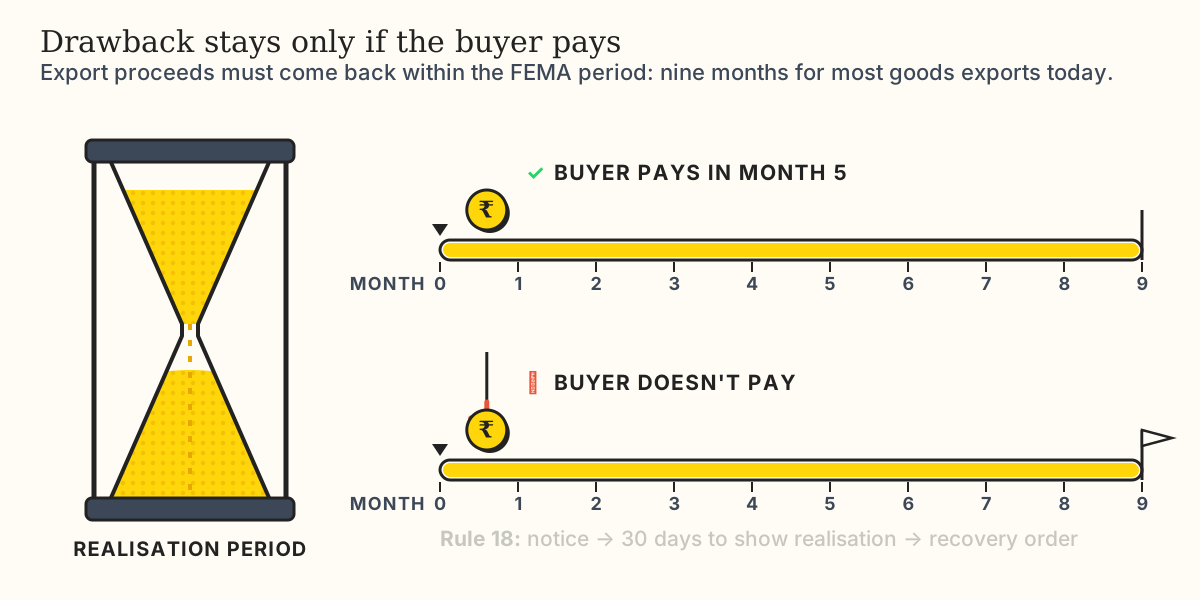
The process is fairly fixed. Customs issues a notice asking you to show that the proceeds were realised. You get 30 days to produce the evidence. If you can't, an order is passed and you have to repay the drawback, with interest. If only part of the money came in, the recovery is proportionate. If the money arrives later, you can apply to get the recovered drawback back, within the time the rules allow.
The data for all of this comes from your bank's realisation reporting, the e-BRC. So the practical advice is simple: make sure your bank is actually reporting realisation against each shipping bill. A payment that arrived but was never linked to the right shipping bill looks exactly like a payment that never arrived.
There are carve-outs in Rule 18 for cases like ECGC insurance claims and RBI-approved write-offs. If a buyer has genuinely defaulted, talk to your bank and your broker early. Don't wait for the notice.
Drawback vs RoDTEP vs IGST refund
These three get mixed up constantly because they all show up in the shipping bill and they all pay something back. They refund different things.
| Duty drawback | RoDTEP | IGST refund | |
|---|---|---|---|
| What it gives back | Customs duty on imported inputs, and central excise on fuel | Embedded taxes that aren't refunded anywhere else, like state levies on fuel and electricity | IGST paid on the export invoice |
| Where it's claimed | Shipping bill, using the drawback serial | Shipping bill, with the RoDTEP declaration | The shipping bill itself is the refund claim |
| How it's paid | Credit to your bank account | Transferable e-scrip, used to pay import duty or sold | Credit to your bank account |
| Biggest risk | Wrong serial, missing EGM, recovery if unpaid | Forgetting to declare it at filing | Shipping bill and GSTR-1 not matching |
Because they cover different taxes, they can usually sit on the same shipping bill. The exceptions come from the scheme you're exporting under. Advance Authorisation, EOU and SEZ status each rule out some of these. RoDTEP in particular has been extended in short spurts, so confirm it's notified for your shipment date before counting on it. And for both RoDTEP and drawback, the declaration has to be right at filing. Our export guide explains why a missed RoDTEP declaration can't be fixed after the let export order.
A quick checklist
Before the shipping bill goes in:
- Is the drawback serial right for what's actually in the carton, including fibre content and blend?
- Is the quantity in the same unit the cap is measured in?
- Does the cap cut your drawback hard enough to look at a brand rate? Decide before filing.
- Are you exporting under Advance Authorisation, EOU or SEZ? Then AIR doesn't apply.
- Is your bank account registered against your IEC with customs, and validated?
After the cargo sails:
- Has the carrier filed the EGM, and does it tie to your shipping bill?
- Is someone checking ICEGATE for queries and drawback status?
- Has the buyer paid, and has the bank linked the realisation to this shipping bill?
For goods going back out under Section 74:
- Do you have identity evidence from arrival? Serials, photos, packing.
- How many months have passed since clearance? Every quarter costs money.
Frequently asked questions
Do I need to file a separate drawback claim?
Not for All Industry Rate drawback. The shipping bill, with the drawback serial declared, is treated as the claim once the let export order is given. Brand rate applications under Rules 6 and 7 are separate and have their own deadline.
How long does drawback take to arrive?
There's no fixed number. If the EGM is filed and nothing gets queried, it can move fairly quickly. Customs owes interest if it isn't paid within a month of the claim. In real life, the delays are almost always one of the causes above: EGM, bank validation, or an unanswered query.
Can I claim drawback and RoDTEP on the same export?
Usually yes. They refund different taxes. The scheme you export under can rule one out, so check if you hold an Advance Authorisation or operate as an EOU or SEZ unit.
Is drawback available if I pay IGST on exports and claim a refund?
The current All Industry Rates cover customs duty on inputs and central excise on fuel, not GST. Your IGST refund is a separate claim, and the two normally sit on the same shipping bill.
What if my buyer pays late?
If the money comes in after the realisation period but you've already had to repay drawback, you can apply to get it back with proof of realisation. If the delay is a known problem, talk to your bank about an extension before the deadline, not after.
I'm a merchant exporter, not a manufacturer. Can I claim drawback?
Yes. All Industry Rate drawback goes to the exporter named on the shipping bill, whether you made the goods or bought them from a factory. A brand rate is harder for a merchant exporter, because it's built on the manufacturer's input data, so you'd need the factory to share its bills of entry and consumption figures.
The short version
Drawback is customs giving back the duty it collected on goods that didn't stay in India. For manufacturers, it's a percentage of FOB with a per-unit cap, claimed in the shipping bill. For goods going straight back out, it's 98% if they're unused and less with every quarter they were used.
The claim is easy. Keeping it is the work: the right serial, the right unit, an EGM that ties, a bank account that validates, and a buyer who pays on time. Each of those is a small check. Skipping any of them turns a quiet refund into a notice months later.
Trinity Freight Services handles export clearance from Chennai and Bengaluru. We pick the drawback serials with you, file shipping bills with every refund declared at the start, and keep checking EGM and drawback status after the cargo has sailed. If you have goods going back out under Section 74, or a drawback claim that's been stuck for months, talk to us.