
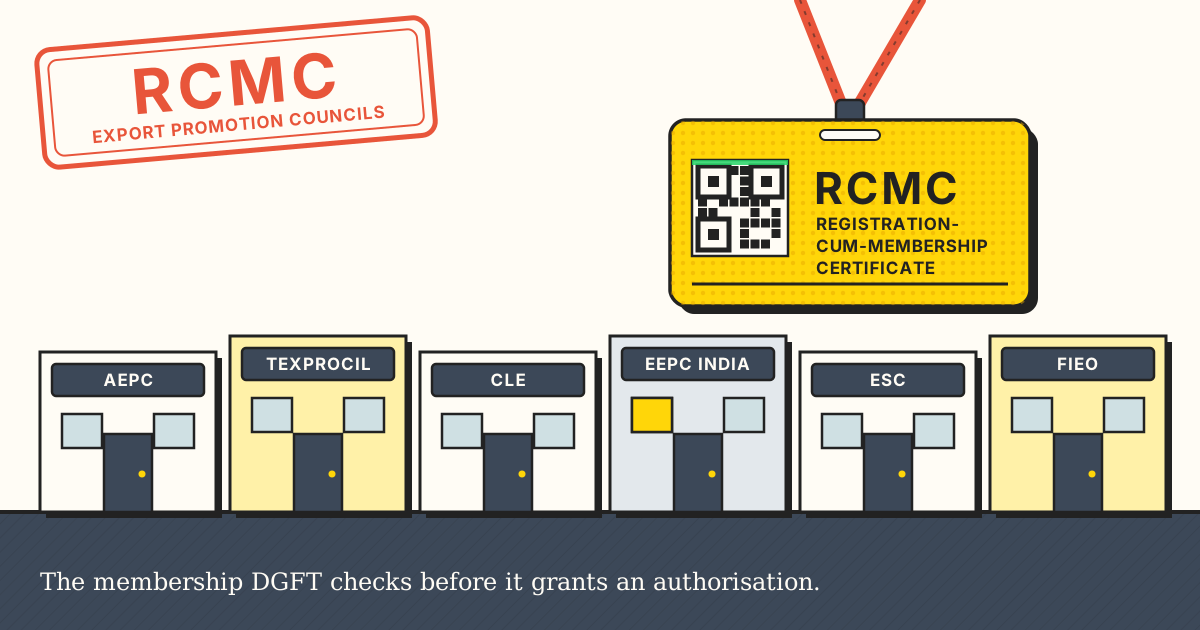
An RCMC, or Registration-cum-Membership Certificate, is proof that you're a registered member of an Export Promotion Council, a commodity board or FIEO. On its own it does nothing at the port. Your shipping bill doesn't ask for it, and customs never sees it. It matters because DGFT asks for it before it gives you most of what the Foreign Trade Policy offers: an Advance Authorisation, an EPCG authorisation, a DFIA, and support under the export promotion schemes.
Plenty of new exporters get one because someone told them they had to, then pay a council's membership fee every year for a certificate they never use. Others find out they need one the week they apply for an Advance Authorisation. This guide is about working out which of those you are before you spend the money.
It covers what the certificate is, when you need one and when you don't, the ₹3 lakh exemption DGFT brought in this September, how to choose the council, the application on DGFT's e-RCMC platform, validity and renewal, what it costs, and the mistakes we see.
What an RCMC is
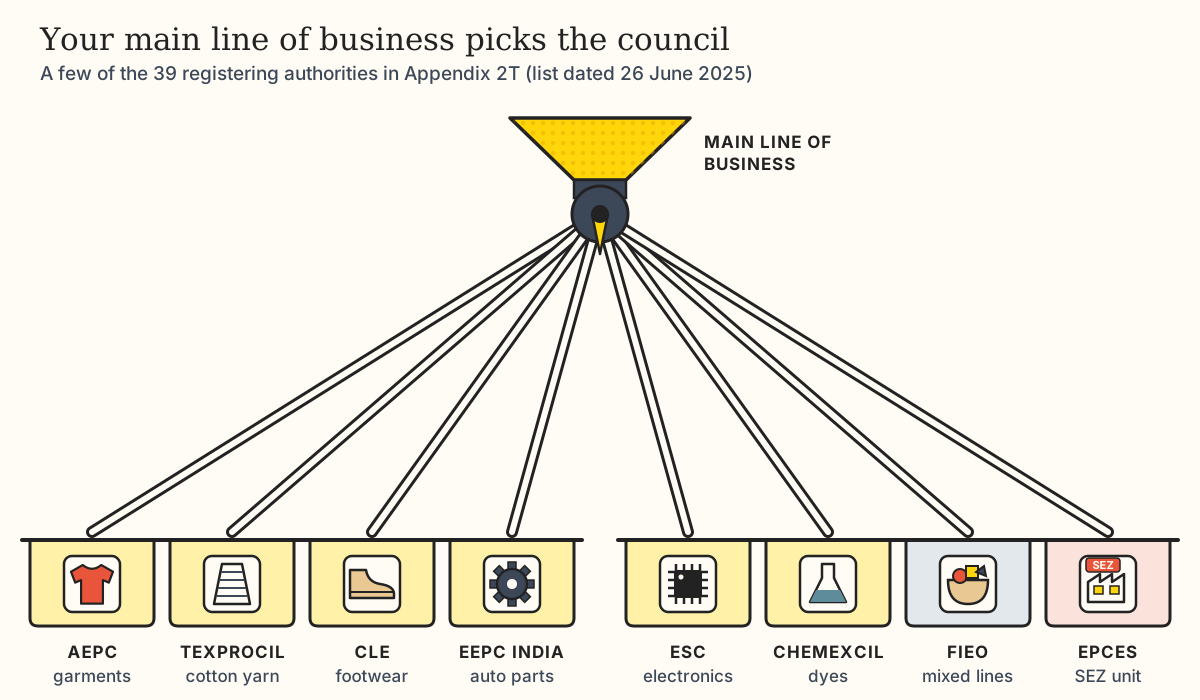
The Foreign Trade Policy defines the RCMC as a certificate of registration and membership granted by an Export Promotion Council, a commodity board, a development authority or another competent authority (FTP 2023, para 11.47). The bodies that can issue one, and the products each covers, are listed in Appendix 2T of the policy. The current list, dated 26 June 2025, has 39 entries: product councils like AEPC for garments and EEPC India for engineering goods, commodity boards like the Coffee Board and the Spices Board, and FIEO for exporters whose products don't fit any one council.
A few points that trip people up:
- It's a membership, issued online. Since April 2022 every RCMC is applied for, issued, renewed and amended through DGFT's common platform. The certificate carries a unique document number and a QR code, and it's linked to your IEC profile automatically.
- Two commodity registrations count as an RCMC. The Spices Board's Certificate of Registration as Exporter of Spices (CRES) and the Coir Board's exporter registration are treated as RCMCs (FTP para 2.57(b)).
- EOUs don't need a separate one. For EOU, EHTP, STP and BTP units, the Development Commissioner acts as the registering authority (HBP para 6.34).
- SEZ units do. The SEZ Rules require units and developers to hold an RCMC, from EPCES, the council for EOUs and SEZs, to claim SEZ exemptions and concessions (SEZ Rules amendment, 2016).
When you actually need one
The rule is in para 2.57(a) of the FTP. Anyone applying for an authorisation to import or export under the policy, other than for items listed as restricted in ITC (HS), or applying for any other benefit or concession under the policy, has to provide an RCMC, unless the policy specifically exempts them.
In practice that splits the policy's benefits into two groups.
You need an RCMC for:
- Advance Authorisation, EPCG and DFIA. The application forms (ANF 4A, ANF 5A and the DFIA forms) each have an RCMC section. For Advance Authorisation, the branch or manufacturing unit has to appear in both your electronic RCMC and your IEC (HBP para 4.03).
- Market access support. The trade-fair and buyer-seller-meet support that replaced the old MAI scheme, under the Export Promotion Mission, requires you to have been a member of the organising council for at least six months before the event (Trade Notice 19/2025-26).
You don't need one for:
- Duty drawback, RoDTEP and RoSCTL. DGFT clarified in October 2024 that the RCMC requirement doesn't apply to these remission schemes (Trade Notice 19/2024-25). There had been confusion, partly because a June 2024 notice had listed an RCMC as a RoDTEP condition for medical devices.
- The IGST refund on exports. It's processed from your shipping bill and GST returns, and the shipping bill itself is the refund claim.
- Shipping goods at all. Your IEC, your AD code registration and a correct shipping bill get goods out of India. The RCMC isn't part of export clearance.
- Interest subvention under the Export Promotion Mission. It needs an active IEC and an Udyam registration (Trade Notice 20/2025-26).
One grey area: a status holder certificate (Star Export House and so on) is based on your IEC and export performance, and its application form doesn't ask for an RCMC. DGFT hasn't said in so many words whether the general rule in para 2.57 still applies to it.
If you're not sure which of these your business will use, our export benefits finder works it out from five questions, RCMC included.
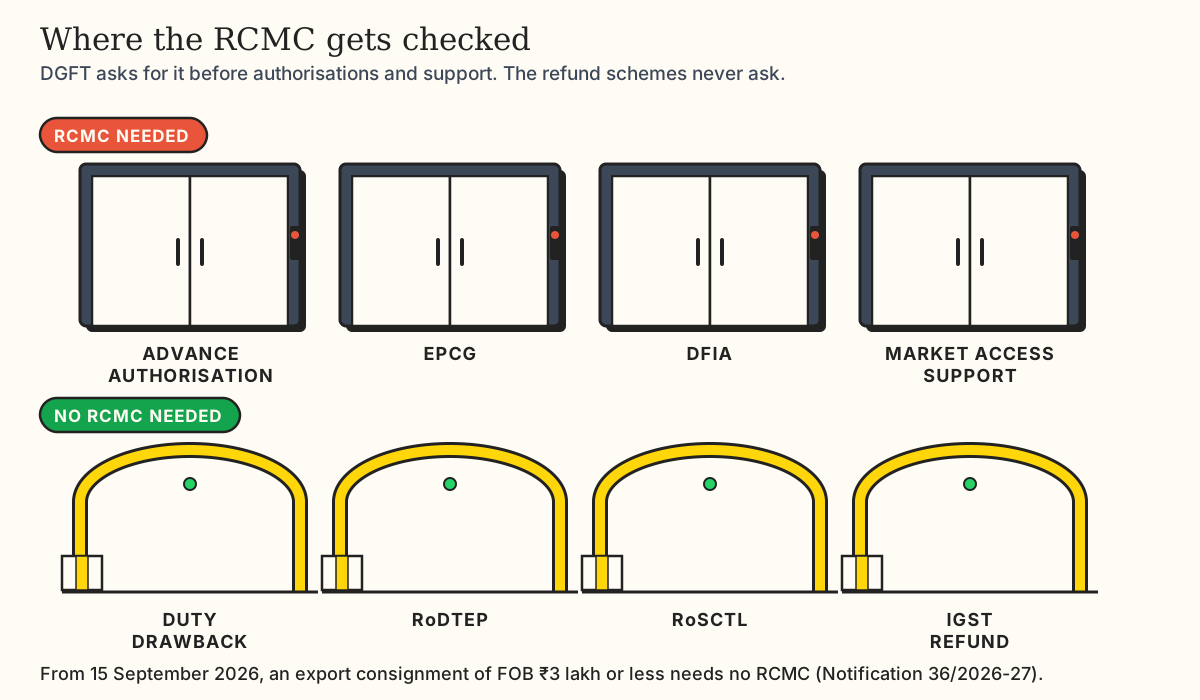
So the decision is simple. If you only plan to export and claim drawback and RoDTEP, you don't need an RCMC to do it. Plenty of councils offer something for the fee anyway: trade-fair stalls, market data, help when a policy changes. If you plan to import inputs duty free under an Advance Authorisation, or machines under EPCG, get the RCMC first, because the authorisation application can't be filed without it.
The new ₹3 lakh exemption
On 15 September 2026, DGFT added a new sub-paragraph to the policy. The RCMC requirement no longer applies to an export consignment with an FOB value of ₹3,00,000 or less (Notification 36/2026-27). The notification says the aim is small-value exports, especially through post, courier and other new channels. Above ₹3 lakh, you still need an RCMC wherever the policy otherwise requires one.
Two cautions. The July 2026 draft of this rule (Trade Notice 14/2026-27) proposed a ₹10,000 limit, and when we checked in October, DGFT's consolidated copy of FTP Chapter 2 still showed the draft wording. The notification is what counts. And the exemption is per consignment. How councils and Regional Authorities will apply a consignment test to applications that cover many shipments, like an Advance Authorisation, isn't spelled out yet. For now, read it as a relief for small courier and postal exporters, not a reason to skip the RCMC before an authorisation.
Which council to join
You take your RCMC from the council that covers your main line of business (HBP para 2.80). Two exceptions:
- FIEO issues RCMCs to multi-product exporters who aren't registered with any council and haven't settled on a main line yet. It also covers products that no council covers.
- Two regional routes. Multi-product exporters headquartered in the North East can register with SHEFEXIL, and handicraft and handloom exporters in Jammu and Kashmir and Ladakh go to the Director of Handicrafts there.
For most exporters around Chennai and Bengaluru, the choice comes down to one of these councils, all listed in Appendix 2T:
| If you mainly export | Council |
|---|---|
| Readymade garments | AEPC (Apparel Export Promotion Council) |
| Cotton yarn, fabrics, made-ups | TEXPROCIL |
| Handloom products | HEPC, headquartered in Chennai |
| Leather, footwear and leather products | CLE (Council for Leather Exports), headquartered in Chennai |
| Machinery, vehicles, auto components, steel products, pumps, tools | EEPC India |
| Electronics hardware, instruments, software and IT services | ESC (Electronics and Computer Software EPC) |
| Mobile phones and electronic devices | MEDEPC |
| Dyes, basic chemicals, cosmetics | CHEMEXCIL |
| Drugs, formulations, diagnostics | Pharmexcil |
| Tyres, ceramics, granite, glass, rubber goods | CAPEXIL |
| Coffee | Coffee Board, headquartered in Bengaluru |
| Products made in an SEZ | EPCES |
| Several product lines, none settled | FIEO |
Product groups sometimes overlap. Appendix 2T settles a few cases itself. Cosmetics go to CHEMEXCIL except AYUSH products, which go to AYUSHEXCIL, and EOUs exporting spices must register with the Spices Board. Medical devices got their own council in 2023, and until it's fully working, EEPC India or another relevant council can issue the RCMC (Trade Notice 05/2024-25).
Our advice: pick the council for the product that makes up most of your export turnover, and the one whose services you'll actually use. A Hosur auto-parts maker belongs with EEPC India, even if it ships a few garments for a sister company.
Applying on the e-RCMC platform
DGFT opened its common e-RCMC platform on 6 December 2021 (Trade Notice 27/2021-22), and since 1 April 2022 every application for issue, renewal or amendment has to go through it (Trade Notice 35/2021-22). You no longer apply to the council directly.
Before you start you need an active IEC, an IEC profile that's up to date, and either a digital signature or Aadhaar e-sign. If your IEC hasn't had its annual update, fix that first. Our IEC guide explains the April to June update.
The application, as DGFT's user guide lays it out:
- Log in at dgft.gov.in and go to Services, then e-RCMC, then Apply for e-RCMC.
- Confirm that your IEC profile is up to date.
- Choose the council or board.
- Fill in the fee details, the council office you're applying to, and the product panel.
- List your export products by ITC (HS) code. There's a bulk upload for long lists.
- Add authorised representatives, export markets and your firm's profile.
- Upload the documents the council asks for. The portal takes up to five files of 5 MB each, PDF or JPG.
- Accept the declaration, sign, and pay the council's fee online through PayGov.
The council then reviews the file. It can mark it deficient and ask for more documents or fees, reject it, or approve it and issue the certificate with its digital signature. Once issued, the RCMC appears in your IEC profile. Anyone can look one up on DGFT's e-RCMC page with the IEC and the first three characters of the firm name (DGFT e-RCMC page).
Documents vary by council. DGFT doesn't set one list. For example, CHEMEXCIL asks for a chartered accountant's certificate of export turnover for the last three financial years, along with PAN, GST, Udyam and IEC copies and a product list with HS codes (CHEMEXCIL document list). TEXPROCIL asks for self-attested copies of IEC, PAN and GST (TEXPROCIL). Check your council's list before you start the form.
Validity and renewal
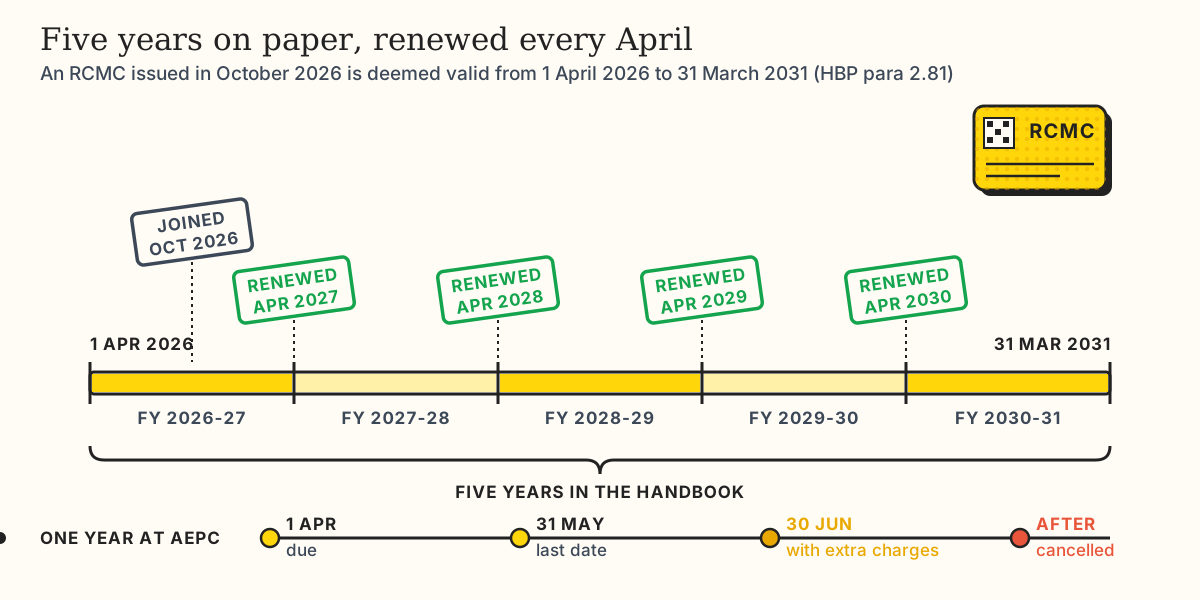
On paper, an RCMC is valid for five years. The Handbook says it's deemed valid from 1 April of the licensing year in which it was issued, and runs for five years ending 31 March, unless otherwise specified (HBP para 2.81). An RCMC issued on 23 October 2026 would run from 1 April 2026 to 31 March 2031.
In practice, councils run membership year by year, and the RCMC follows the membership.
- EEPC India says membership expires on 31 March every financial year (EEPC India).
- CLE says the RCMC's validity depends on renewing membership every financial year (CLE circular, March 2026).
- AEPC's subscription falls due on 1 April and is payable by 31 May, and it's accepted with extra charges up to 30 June. AEPC says non-renewal cancels the RCMC automatically (AEPC).
The portal also lets councils set validity of one to five years. So treat your RCMC as an annual membership. Renew in April, and check the expiry date on the certificate itself.
A few rules for keeping it in order:
- Renewal on the e-RCMC platform opens once the certificate has expired, and the RCMC number stays the same.
- Amendments, such as a new product or branch, are filed on the same platform and flow into your IEC profile when approved.
- Changes in ownership, constitution, name or address must be reported to the council within one month (HBP para 2.82).
- De-registration. A council can de-register a member who breaks the conditions of registration, after a show-cause notice. You can appeal to DGFT within 45 days (HBP paras 2.83 and 2.84).
What it costs
The fee is the council's membership fee, which you pay through the DGFT portal. Each council sets its own, usually in slabs by your export turnover, and they change every year. Some examples for 2026-27 from the councils' own websites:
| Council | Fee (2026-27) |
|---|---|
| AEPC | New members ₹12,000 + GST, plus ₹1,000 entrance. Renewal from ₹12,000 + GST, rising with turnover |
| EEPC India | From ₹6,500 for exports up to ₹30 lakh, up to ₹75,000 above ₹500 crore, plus ₹2,000 admission. GST at 18% on top |
| CHEMEXCIL | Renewal from ₹6,500 + ₹1,170 GST for exports up to ₹10 lakh, up to ₹55,000 + GST above ₹1,000 crore. New members also pay an entry fee |
| ESC | Annual fee from ₹10,000 + ₹1,800 GST for exports up to ₹10 lakh, up to ₹29,000 + GST for ₹1 crore and above |
Sources: AEPC, EEPC India, CHEMEXCIL slab for 2026-27, ESC. We couldn't check FIEO's current fee because its website was unreachable when we looked, so ask FIEO directly.
Mistakes we see
Joining the wrong council. The product you happened to ship first isn't always your main line. If most of your turnover is engineering goods, an RCMC from a textile council will raise questions when you apply for an authorisation.
Letting membership lapse just before an application. The Regional Authority expects a valid RCMC when you apply. An April renewal that slipped to July can hold up an Advance Authorisation for weeks.
Leaving the factory off the RCMC. For an Advance Authorisation, the branch or manufacturing unit has to appear in both your RCMC and your IEC. Add new units by amendment before you apply.
Paying for an RCMC you don't use. If you only export and claim drawback and RoDTEP, the certificate isn't required. Join a council for its services if they're worth it to you, not because of a rule that doesn't apply.
Applying with a stale IEC profile. The e-RCMC application asks you to confirm your IEC profile is current, and it pulls your details from it. Update the IEC first.
Frequently asked questions
What is the full form of RCMC?
Registration-cum-Membership Certificate. It's issued by an Export Promotion Council, a commodity board, FIEO or another authority listed in Appendix 2T of the Foreign Trade Policy.
Is an RCMC mandatory for exporting?
Not for exporting itself. You need an IEC to export. The RCMC is needed when you apply to DGFT for an authorisation or for support under the Foreign Trade Policy, such as Advance Authorisation or EPCG.
Do I need an RCMC for RoDTEP or duty drawback?
No. DGFT's Trade Notice 19/2024-25 says the RCMC requirement doesn't apply to drawback, RoDTEP or RoSCTL.
How long is an RCMC valid?
The Handbook says five years, counted from 1 April of the year it was issued. Councils renew membership every financial year, and some cancel the RCMC if you don't renew, so plan on renewing every April.
Which Export Promotion Council should I register with?
The one that covers your main line of business. FIEO is the option for multi-product exporters who haven't settled on a main line, and for products no council covers. SEZ units register with EPCES.
Can I apply for an RCMC online?
Yes, and it's the only way. Since 1 April 2022, applications for issue, renewal and amendment go through DGFT's e-RCMC platform.
Do small exporters need an RCMC?
Since 15 September 2026, the requirement doesn't apply to an export consignment with an FOB value of ₹3 lakh or less. Above that, the usual rule applies.
The short version
An RCMC is a council membership that DGFT checks before it gives you an authorisation or support under the Foreign Trade Policy. You need one for Advance Authorisation and EPCG. You don't need one to export, or to claim drawback, RoDTEP or the IGST refund. Join the council for your main line of business, apply on DGFT's e-RCMC platform, and renew every April, whatever the five-year validity on paper says.
Trinity Freight Services handles export clearance and authorisation imports at Chennai and Bengaluru. If you're deciding whether an Advance Authorisation or EPCG is worth getting, and whether you need the RCMC that goes with it, talk to us before you pay the membership fee.