
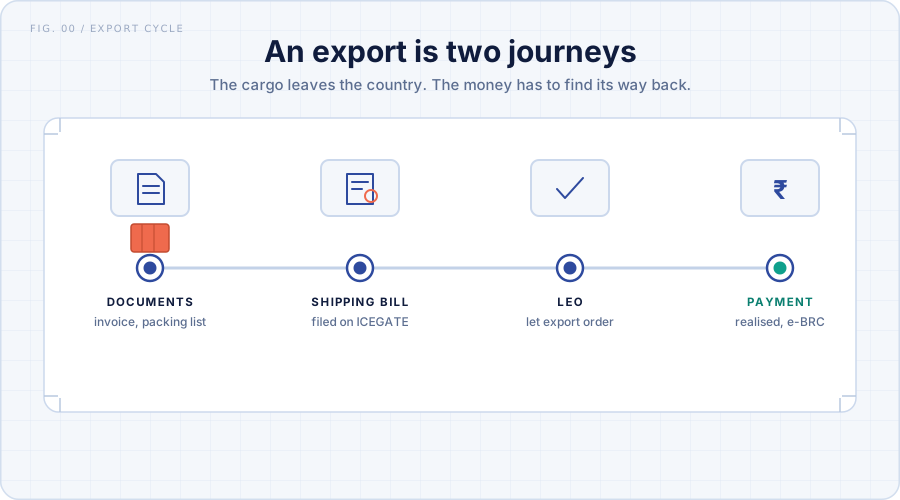
A garment unit near Tiruppur shipped its first export order two years ago. Forty cartons, one buyer in Rotterdam, a price everyone was happy with. The cargo sailed on time. The buyer received it, inspected it, and paid within terms.
Five months later the owner was still chasing his IGST refund.
The cargo had never been the problem. The shipping bill carried a different invoice number from the one filed in his GSTR-1, the carrier's export manifest had a typo in the container number, and nobody noticed either until the refund did not arrive. By then the money he had paid as IGST had been sitting with the government for most of two quarters, and his working capital had gone with it.
That is the part first-time exporters underestimate. Getting goods out of India is mostly logistics, and logistics can be bought. Getting the money back is a paperwork chain, and every link in it is filed by somebody else.
This guide walks through both halves: what you need registered before you can file anything at all, the documents involved and who issues each one, what actually happens at the port in the last three days, and how the refunds and the buyer's payment eventually close the loop.
The four registrations that come before everything
Without all four of these in place, the system simply refuses the shipping bill. There is nothing to negotiate and nobody to escalate to.
IEC, your Importer Exporter Code. A ten-digit code from DGFT, same as your PAN, applied for online and usually issued within a day or two. The catch nobody mentions is that it has to be confirmed on the DGFT portal every year between April and June, even if nothing about your business has changed. Miss that window and the IEC goes inactive, and you find out when a shipping bill bounces.
AD code registration at your port. Your bank gives you an Authorised Dealer code letter. That code then has to be registered against the specific port, airport or ICD you are shipping from. Registered at Chennai does not mean registered at Bengaluru air cargo. Every new port is a fresh registration, and the first shipment through a new port is where this always surfaces, usually on the morning the cargo is already at the gate.
LUT, if you want to export without paying IGST. Exports are zero rated, but there are two ways to get there. File a Letter of Undertaking on the GST portal and you ship without paying IGST at all. Skip the LUT and you must pay IGST on the export invoice and claim it back later. The LUT is free, takes minutes, and expires at the end of every financial year, so it needs renewing each April. Plenty of exporters pay IGST for a whole year purely because nobody renewed a form.
Your bank account linked on ICEGATE. Refunds and drawback are credited to the account you have registered against your IEC in customs' system. A closed account or a stale IFSC is a common reason for a refund that has technically been sanctioned but has not landed.
Get these four done before you quote, not after the buyer confirms the order. All four are free or nearly free, and all four take longer than you expect the first time.
Sixteen documents, four different owners
The export document set looks overwhelming until you sort it by who produces each piece. Then it becomes four short lists, and only one of them is yours to chase directly.
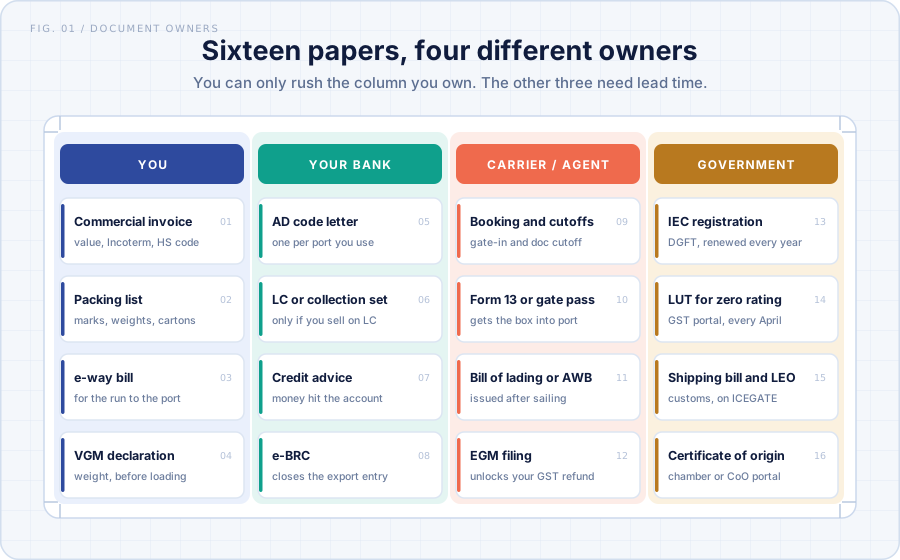
What you raise yourself. The commercial invoice and packing list do most of the work, and they need to agree with each other exactly. Same invoice number, same quantities, same weights, same HS code, same Incoterm. Add the e-way bill for the road leg to the port and the VGM declaration for the container's verified weight, which has to reach the line before their cutoff or the box does not get loaded.
What your bank produces. The AD code letter up front, then the collection or letter of credit documents if you sell on those terms, then the credit advice when money arrives, then the e-BRC that closes the file. Banks work to their own timelines, so build in slack.
What the carrier or your agent handles. Booking and cutoff times, the gate pass that gets your container into the port, the bill of lading or air waybill after departure, and the export general manifest filed once the vessel has sailed. That last one is theirs, not yours, and it controls your refund.
What comes out of government systems. Your IEC, your LUT, the shipping bill and the let export order from customs, and the certificate of origin, either from a chamber of commerce or through the DGFT common digital platform if your buyer is claiming a preferential rate under a trade agreement.
Product-specific paperwork sits on top of this. Wooden packing needs ISPM-15 fumigation. Food and agricultural cargo needs phytosanitary certification. Chemicals need an MSDS and a dangerous goods declaration. Some buyers want third party inspection before loading. None of these are quick, and all of them are easier to arrange three weeks out than three days out.
The last three days before the ship
Once the cargo is packed, the sequence at the port is fixed. You cannot reorder it, and each step waits for the one before it.
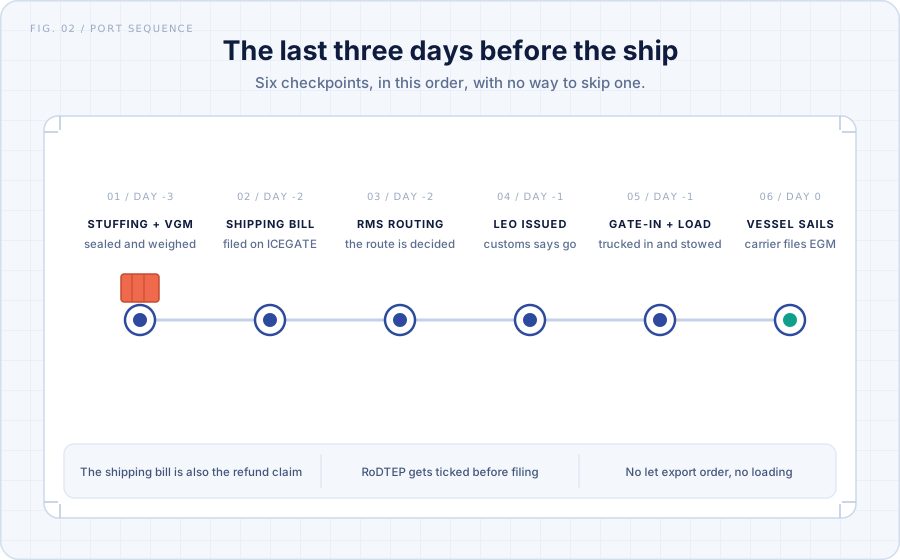
Stuffing and VGM. Cargo is loaded, the container is sealed, and the verified gross mass goes to the line. For LCL cargo this happens at the consolidator's CFS instead, on their schedule rather than yours.
Shipping bill filed on ICEGATE. Your customs broker files it electronically against your IEC and AD code. This is the single most important document in the whole export, and the next section explains why.
RMS routing. Customs' risk management system decides in seconds whether your shipment is facilitated or picked for examination. Facilitated means it moves straight through. Selected means physical examination, which adds a day or two and needs somebody present who can open, present and repack the cargo.
Let export order. The proper officer grants the LEO once assessment and any examination are complete. Nothing loads before this. If your cargo is sitting at the port without an LEO and the vessel cutoff is tonight, you are rolling to the next sailing.
Gate-in and loading. The container moves into the terminal and onto the vessel. Miss the gate-in cutoff and you also risk port storage charges, which behave much like the demurrage and detention meters importers get caught by.
Sailing, then the EGM. After departure the carrier files the export general manifest. Your bill of lading is issued around now, and the shipped on board date on it matters if you are presenting documents under a letter of credit.
Notice how little of that list is actually yours. Steps two, three and four belong to customs, step six belongs to the carrier. You control the packing, the quality of the paperwork and the transport, and everything else you can only prepare for.
The shipping bill is doing two jobs
The shipping bill is customs permission to export. It is also, at the same time, your claim for the money the government owes you back. Under the IGST-paid route it functions as the refund application itself, with no separate form to file. Duty drawback and RoDTEP are claimed through declarations made inside it.
Which leads to the rule that costs people the most: RoDTEP has to be claimed at the time of filing. You declare intent in the shipping bill. If that declaration is missed, the benefit is gone for that shipment, and no amount of follow-up afterwards brings it back. On thin export margins, forgetting a tick box can wipe out a meaningful slice of what you made on the order.
The refund side splits by which route you chose:
| Export under LUT | Export with IGST paid | |
|---|---|---|
| What you pay upfront | No IGST on the export invoice | IGST at the applicable rate |
| What you claim back | Unutilised input tax credit | The IGST you paid |
| How you claim it | Separate refund application on the GST portal | Automatic, through the shipping bill |
| Cash flow effect | Nothing blocked | Cash blocked until refund |
| Usually suits | Regular exporters | Occasional exporters, or those with large ITC balances |
Neither route is universally better. Regular exporters mostly file the LUT because blocking cash on every shipment is painful. Businesses sitting on a large input credit balance sometimes prefer the IGST route because the refund is automatic and moves faster than an ITC refund application.
Getting paid, and proving you got paid
Two separate chains have to complete after the ship sails, and they do not depend on each other.
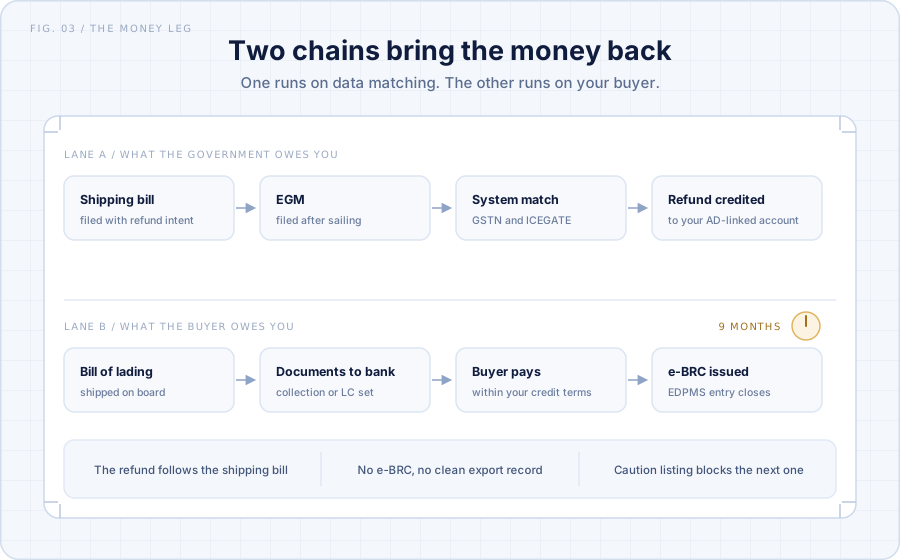
The government chain runs on matching. Your shipping bill has to line up with the carrier's EGM, and both have to line up with the invoice details you filed in your GST return. When all three agree, the refund is processed and credited without you doing anything. When one of them disagrees, nothing happens and nobody calls you. Invoice number mismatches between the shipping bill and GSTR-1 have historically been the biggest single cause of stuck IGST refunds, and EGM errors are close behind. Both are fixable, but only once you know they exist, which is why checking refund status a couple of weeks after sailing is worth the ten minutes.
The buyer chain runs on your sales terms. Documents go to the bank, the buyer pays against them or against agreed credit terms, and once the money lands your bank reports the realisation and the e-BRC is generated. That certificate is what closes the export entry in the banking system, and you need it for most export incentive claims.
Two rules about realisation matter more than most exporters expect. Under FEMA, export proceeds generally have to be realised within nine months of shipment. Bills that stay open in the banking system beyond that get escalated, and exporters who accumulate unrealised entries eventually land on a caution list that makes future shipments considerably harder. In that situation an unpaid invoice becomes a compliance problem attached to your IEC, on top of being money you never received.
If a buyer genuinely cannot pay or a shipment goes wrong, talk to your bank early. There are proper routes for extensions and write-offs. Silence is what gets you caution-listed.
Five mistakes that cost first-time exporters real money
1. Quoting before understanding the Incoterm. An exporter who quotes CIF and prices it like FOB has just given away the ocean freight. Agree the Incoterm before you quote, and be specific about which charges sit on which side of the line, because the named terminal matters as much as the three letters.
2. Letting the invoice and the shipping bill drift apart. A revised invoice that never made it to the broker, a rounding difference in weight, a changed HS code. Any of these will sit quietly until refund time. Freeze the commercial invoice before filing, and if it changes afterwards, tell your broker the same day.
3. Assuming the port registration will sort itself out. AD code registration at a new port takes days, not hours, and it is entirely avoidable pain. Do it when you first plan to ship from that port.
4. Treating the buyer's document list as optional. Letters of credit are unforgiving. A description that does not match the LC word for word, a missing certificate, a late presentation, and the bank raises a discrepancy. The goods are gone, the paperwork is wrong, and your leverage has evaporated. Read the LC the day it arrives, not the week you ship.
5. Ignoring the refund until it is late. The refund is not somebody else's job. Nobody in the chain has an incentive to tell you it is stuck. Check status after sailing, on every shipment, until it becomes routine.
What this looks like from Chennai and Bengaluru
Exporters shipping sea freight through Chennai are mostly managing cutoffs. Stuffing schedule, VGM cutoff, document cutoff, gate-in cutoff, all of them ahead of the sailing date and none of them flexible. Factory stuffing gives you cleaner control of that timeline than moving loose cargo to a CFS and hoping the consolidator's plan holds.
For businesses around Bengaluru, the split is between air cargo out of the city and sea cargo trucked down to Chennai. Air shortens the transit and simplifies the port sequence, but it changes the paperwork rhythm: cutoffs are tighter, the airline's manifest matters as much as a shipping line's EGM, and the freight cost of the export leg is high enough to affect your buyer's landed cost calculation. Sea via Chennai means adding the inland leg, the e-way bill and a realistic buffer for the drive, particularly during monsoon.
Either way, the useful arrangement is having the same team handle the export clearance and the coordination around it. If you also bring in raw material, running import clearance through the same people means one set of records against one IEC, which makes the annual compliance far less painful. A freight forwarder who books the space and a broker who files the papers should be working from the same timeline, not two separate ones.
Before your first shipment leaves
Run through this and most of the expensive surprises disappear:
- Is the IEC active and confirmed for this financial year?
- Is the AD code registered at this specific port or airport?
- Is the LUT valid for the current financial year, or are you paying IGST deliberately?
- Is the bank account on ICEGATE the one you actually use?
- Do the invoice, packing list and shipping bill carry identical numbers, quantities and weights?
- Is the RoDTEP declaration going into the shipping bill at filing?
- Are the product-specific certificates arranged, with lead time?
- Does the document set match what the LC or the buyer asked for, word for word?
- Do you know the VGM, document and gate-in cutoffs, not just the sailing date?
- Do you know who is checking refund status, and when?
The short version
An export is two journeys. The cargo goes out, which is the visible half and the half everyone plans for. The money comes back, which is the half that runs on data matching, bank reporting and deadlines nobody reminds you about.
First shipments almost never fail on the cargo. They fail on a registration that lapsed, a number that did not match, or a claim that was never declared. All three are cheap to prevent and expensive to fix afterwards, which is a reasonable description of export compliance generally.
Trinity Freight Services handles export clearance from Chennai and Bengaluru, including first-time exporters getting registrations in place. We file shipping bills with the refund claims declared correctly the first time, and we follow the shipment through EGM and refund status rather than stopping at the gate. Talk to us about your next export.