
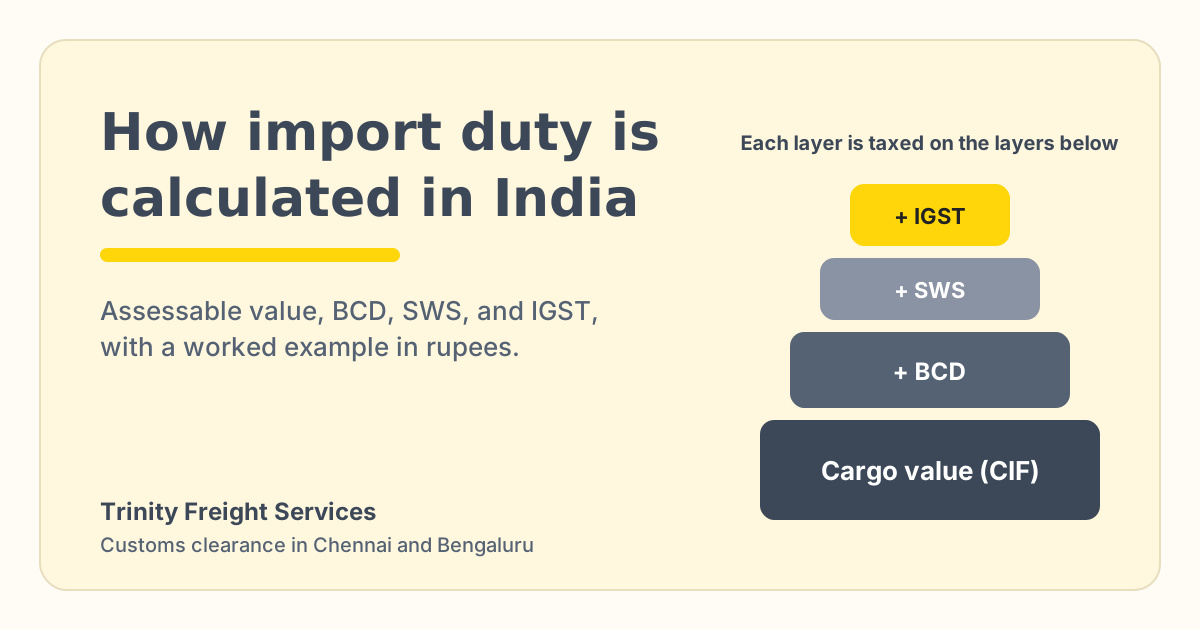
Every importer eventually asks the same question, usually while staring at a quote or a Bill of Entry: how exactly did this duty amount get so large?
The answer is not one tax. It is a stack of charges, each calculated on top of the one before it. Once you see the stack clearly, you can estimate your landed cost before you place an order, instead of discovering it after the cargo has already sailed.
In this guide, we will walk through how import duty is actually calculated in India, work through a full example with real numbers, and cover the details that catch first-time importers off guard.
The duty stack: what you actually pay
When goods are imported into India, the total duty is usually built from these components:
- Assessable value, the base on which everything else is calculated
- Basic Customs Duty (BCD), the core import tariff
- Social Welfare Surcharge (SWS), a surcharge on the BCD
- IGST, the GST applied to imports
- GST Compensation Cess, only on specific goods such as cars, tobacco, and aerated drinks
Some products also attract anti-dumping duty or safeguard duty, but those apply to specific goods from specific countries, not across the board.
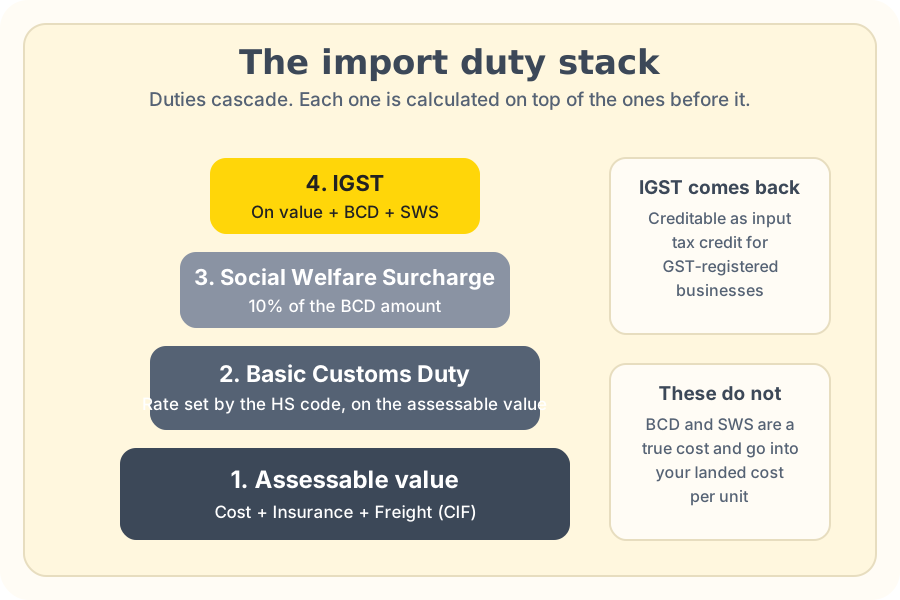
The key thing to understand is that these are cascading, not parallel. IGST is not charged on your invoice value. It is charged on your invoice value plus the duties already added. That compounding is what surprises most people.
Step 1: Work out the assessable value
Everything starts with the assessable value. For most imports, this is the CIF value of the shipment:
- Cost of the goods as per the invoice
- Insurance for the journey
- Freight to the Indian port
If your supplier quoted you on CIF terms, the invoice value is already close to your assessable value. If you bought on FOB or EXW terms, freight and insurance get added before duty is calculated. This is one of the quiet ways Incoterms affect your landed cost.
Two practical points:
- The value is converted to rupees using the exchange rate notified by CBIC, not the bank rate on the day you pay. CBIC publishes these rates periodically, and the rate in force on the date of filing the Bill of Entry applies.
- Customs can question a declared value that looks too low compared with similar imports. Under-invoicing to save duty is not a shortcut; it is a penalty and seizure risk.
Step 2: Apply Basic Customs Duty (BCD)
BCD is the main import tariff, and its rate depends entirely on the HS code of your product. Rates commonly range from 0% to 10% for most industrial goods, with higher rates on items the government wants to discourage importing or protect domestically.
This is why classification is not paperwork trivia. Two similar-sounding HS codes can carry very different BCD rates, and the code you declare determines what you pay, what licences apply, and whether any exemption notification covers your product.
BCD is calculated on the assessable value:
BCD = Assessable value × BCD rate
Step 3: Add the Social Welfare Surcharge (SWS)
SWS is charged at 10% of the BCD amount, not 10% of the cargo value. So if your BCD works out to ₹1,00,000, the SWS is ₹10,000.
A few goods are exempt from SWS, and where BCD is nil, SWS is generally nil too. But for a typical commercial import, assume it applies.
Step 4: Calculate IGST on the duty-inclusive value
This is the step where the cascading effect shows up. IGST is charged at the same rate the product would attract under GST domestically, usually 5%, 12%, 18%, or 28%. But it is calculated on the assessable value plus BCD plus SWS:
IGST = (Assessable value + BCD + SWS) × IGST rate
For goods that attract Compensation Cess, the cess is calculated on the same duty-inclusive base.
A worked example
Say you are importing machinery components with an assessable value of ₹10,00,000, a BCD rate of 10%, and an IGST rate of 18%.
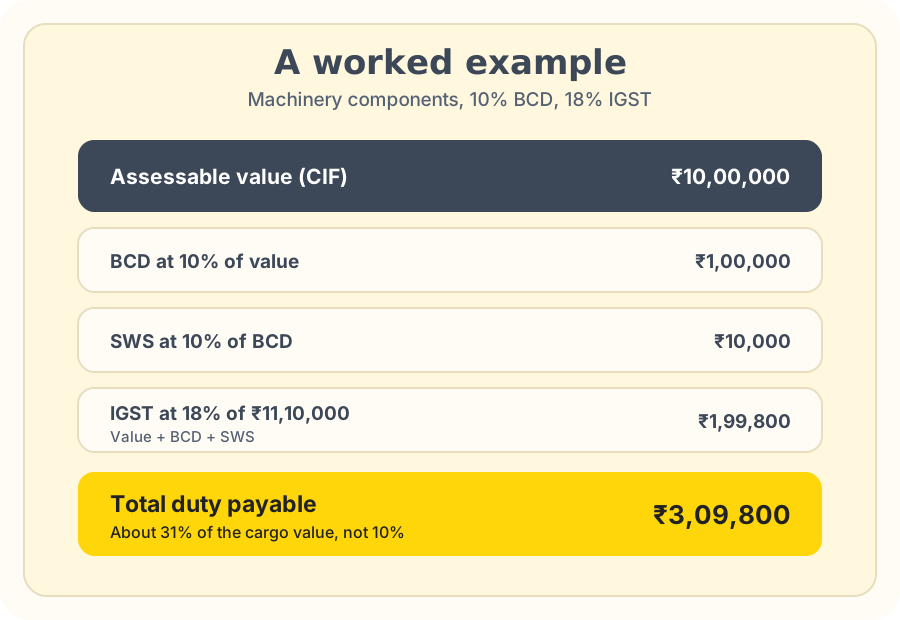
| Step | Calculation | Amount |
|---|---|---|
| Assessable value (CIF) | - | ₹10,00,000 |
| BCD at 10% | 10% × ₹10,00,000 | ₹1,00,000 |
| SWS at 10% of BCD | 10% × ₹1,00,000 | ₹10,000 |
| IGST base | ₹10,00,000 + ₹1,00,000 + ₹10,000 | ₹11,10,000 |
| IGST at 18% | 18% × ₹11,10,000 | ₹1,99,800 |
| Total duty payable | BCD + SWS + IGST | ₹3,09,800 |
Notice two things. First, the total outgo is about 31% of the cargo value even though the "duty rate" most people quote is 10%. Second, the IGST alone is nearly two-thirds of the total payment, and that part behaves very differently from the rest, which brings us to the point most importers miss.
Try it with your own numbers
Plug in your shipment's assessable value and rates to see the full stack for your import. If you are not sure of the BCD rate for your product, our HS code pages list standard rates for common codes.
| Component | Amount |
|---|
This estimate assumes SWS at 10% of BCD and no product-specific cesses (AIDC, NCCD, Health Cess), exemption notifications, FTA preference claims, or anti-dumping duty. Treat it as a planning number, not a Bill of Entry.
Which duties are a real cost, and which come back
If you are a GST-registered business importing for business use, the IGST you pay at customs is available as input tax credit, the same as GST on a domestic purchase. It affects your cash flow at the time of clearance, but it is not a permanent cost.
BCD and SWS are not creditable. They are a true cost and go straight into your landed cost per unit.
So in the example above, the real duty cost for a GST-registered importer is ₹1,10,000, while ₹1,99,800 is cash blocked until it is claimed as credit. If you are comparing supplier quotes or pricing your product, this distinction changes the math completely.
Where the rate can drop: exemptions and trade agreements
The BCD rate in the tariff is not always the rate you have to pay.
- Free trade agreements such as the India–ASEAN agreement, the India–UAE CEPA, and the India–Australia ECTA offer reduced or nil BCD on covered products, provided you produce a valid Certificate of Origin and meet the rules of origin.
- Exemption notifications reduce or remove duty on specific goods, specific end uses, or specific industries. These change frequently with budgets and policy updates.
- Project imports, EPCG, and Advance Authorisation schemes can reduce duty for capital goods and export-linked manufacturing.
This is an area where a good customs clearing agent earns their fee many times over. Claiming an FTA benefit needs the right documentation lined up before filing, not discovered afterwards.
Common mistakes that inflate your duty
Estimating duty on the invoice value alone
If you bought FOB and forget that freight and insurance join the assessable value, your estimate will be low, and air freight makes this gap much bigger than sea freight.
Using the wrong HS code
A misclassified product can mean paying a higher rate than necessary, or paying a lower rate now and facing a differential duty demand with interest and penalty later. Neither is good. Get the classification right first.
Ignoring anti-dumping duty
For products like certain steel items, chemicals, and tiles from specific countries, anti-dumping duty can exceed the BCD itself. Always check before committing to a supplier, not after.
Treating IGST as a cost in pricing
If you price your product assuming the full 31% from our example is a cost, you will quote yourself out of the market. If you assume none of it is, you will underestimate the working capital you need at clearance time.
Not budgeting for the cash flow hit
Duty is paid before the goods are released. On larger shipments, that is a meaningful sum that has to be ready when the Bill of Entry is assessed, or your cargo sits at the port collecting demurrage.
How this plays out at Chennai and Bengaluru
For importers clearing through Chennai, the duty calculation itself is the same as anywhere in India, but timing matters. Sea shipments often involve larger consignments, so the duty payment is a bigger single outflow, and aligning funds with vessel arrival avoids demurrage.
For businesses around Bengaluru, a lot of cargo moves by air, where freight is a much larger share of CIF value. The same product imported by air can carry noticeably more duty than by sea, simply because the assessable value is higher. That trade-off belongs in your air-versus-sea decision, not just the freight quote.
Estimating duty before you order
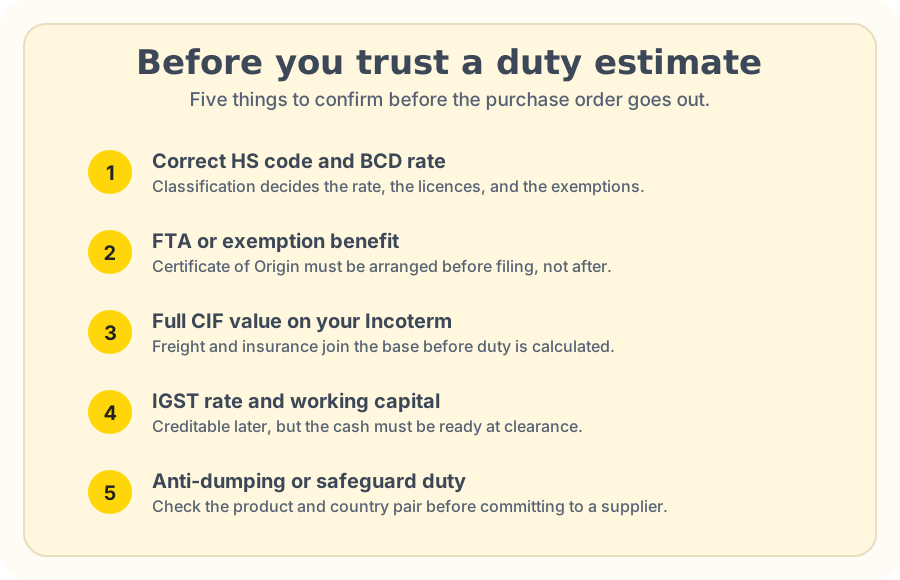
Before you confirm a purchase order, you should be able to answer:
- What is the correct HS code, and what BCD rate does it carry?
- Does any FTA or exemption notification apply, and can your supplier provide a Certificate of Origin?
- What will the CIF value be after freight and insurance, on your chosen Incoterm?
- What is the IGST rate, and how much working capital does clearance need?
- Is there any anti-dumping or safeguard duty on this product from this country?
If you can answer those five questions, your landed cost estimate will usually land within a few percent of the final Bill of Entry. If you cannot, that is exactly the conversation to have with your clearing agent before the order goes out, not when the cargo arrives.
Conclusion
Import duty in India is predictable once you understand the stack: assessable value, then BCD, then SWS on the BCD, then IGST on the whole pile. The headline tariff rate is only the starting point, and the real numbers depend on classification, Incoterms, trade agreements, and whether you can claim the IGST back.
The importers who get surprised are almost always the ones who estimated from the invoice value and a single rate. The ones who do not are the ones who priced the full stack before placing the order.
Trinity Freight Services handles import customs clearance through Chennai and Bengaluru, including duty estimation, HS classification, and FTA benefit claims before your shipment arrives. Contact us for a duty estimate on your next import.