
When you need to ship goods internationally, you face a bewildering array of choices - shipping lines, airlines, customs regulations, documentation requirements, and logistics coordination. This is where a freight forwarder becomes your most valuable partner.
In this comprehensive guide, we'll explain everything Indian businesses need to know about freight forwarders - what they do, how they work, and how to choose the right one for your international trade needs.
What is a Freight Forwarder?
A freight forwarder is a company that specialises in arranging the storage and shipping of goods on behalf of businesses. Think of them as the architects of international logistics - they don't own ships or aircraft, but they design and manage the entire journey of your cargo from origin to destination.
The term comes from "forwarding" your freight to its destination, coordinating multiple parties and services to make it happen seamlessly.
In India, freight forwarders are regulated by the Directorate General of Shipping and must comply with IATA (International Air Transport Association) regulations for air freight. Many also hold customs clearing agent licenses, allowing them to provide integrated door-to-door services.
What Does a Freight Forwarder Do?
1. Carrier Selection and Booking
A freight forwarder maintains relationships with multiple shipping lines, airlines, and road transporters. When you need to ship goods, they:
- Evaluate options across different carriers based on your priorities (cost, speed, reliability)
- Negotiate rates using their volume leverage (often better than what you'd get directly)
- Book space on vessels, aircraft, or trucks
- Provide alternatives when your first choice isn't available
This carrier-agnostic approach means you always get the best option for your specific shipment, not just whatever one carrier offers.
2. Route Planning and Optimisation
International shipping rarely involves a straight line from A to B. Your freight forwarder plans the optimal route considering:
- Transit times and connection schedules
- Transhipment points and associated risks
- Port congestion and seasonal factors
- Cost trade-offs between different routing options
- Special requirements for temperature-sensitive or hazardous goods
A shipment from Chennai to Hamburg, for example, might go direct, or via Colombo, Singapore, or Port Klang - each with different timelines and costs. Your freight forwarder knows which option makes sense for your cargo.
3. Documentation Management
International shipping generates mountains of paperwork. Your freight forwarder prepares and manages:
- Bills of Lading (for sea freight) or Airway Bills (for air freight)
- Commercial invoices and packing lists
- Certificates of Origin for preferential duty treatment
- Letters of Credit documentation for bank financing
- Insurance certificates
- Dangerous goods declarations where applicable
- Phytosanitary certificates for agricultural products
They ensure every document meets the requirements of origin and destination countries, banking institutions, and regulatory bodies.
4. Cargo Consolidation (LCL Shipping)
Not every shipment fills a full container. Freight forwarders offer Less than Container Load (LCL) services by:
- Consolidating multiple shippers' cargo into single containers
- Reducing costs by sharing container space with other businesses
- Providing flexibility for smaller or irregular shipments
- Maintaining regular schedules even for partial loads
This makes international shipping accessible to small and medium businesses who don't have the volume for Full Container Load (FCL) shipments.
5. Customs Clearance Coordination
While customs clearing agents handle the actual clearance process, freight forwarders coordinate with them to ensure:
- Documents reach customs at the right time
- Duties and taxes are paid promptly
- Clearance timing aligns with cargo arrival
- Any issues are communicated and resolved quickly
Many freight forwarders, including Trinity Freight Services, have in-house customs clearance capabilities, providing seamless import and export services.
6. Cargo Insurance
International shipping carries inherent risks - rough seas, handling damage, theft, or natural disasters. Your freight forwarder:
- Advises on coverage options appropriate for your cargo
- Arranges marine cargo insurance through their insurance partners
- Handles claims if damage occurs
- Ensures proper documentation for coverage validity
Carrier liability is typically limited (around $500 per package for sea freight), so proper cargo insurance is essential for valuable shipments.
7. Warehousing and Distribution
Freight forwarding often extends beyond port-to-port movement:
- Origin warehousing for export consolidation
- Destination warehousing for import deconsolidation
- Inventory management for regular shippers
- Last-mile delivery to final destination
- Cross-docking for time-sensitive cargo
This makes freight forwarders valuable partners for managing your entire supply chain, not just international transport.
8. Tracking and Visibility
Modern freight forwarders provide real-time visibility into your shipments:
- Milestone tracking from pickup to delivery
- Proactive alerts for delays or issues
- Documentation access through online portals
- Regular status updates via email or messaging
You always know where your cargo is and when it will arrive.
Types of Freight Forwarding Services
Sea Freight
Sea freight accounts for over 80% of global trade by volume. Freight forwarders offer:
Full Container Load (FCL)
- Exclusive use of 20' or 40' containers
- Lower per-unit cost for larger shipments
- Reduced handling and damage risk
- Faster customs clearance (sealed containers)
Less than Container Load (LCL)
- Share container space with other shippers
- Economical for smaller shipments (1-15 CBM)
- Regular weekly departures on major routes
- Flexible for variable shipping volumes
Special Equipment
- Refrigerated containers (reefers) for perishables
- Open-top containers for oversized cargo
- Flat racks for heavy machinery
- Tank containers for liquids
Air Freight
When speed matters more than cost, air freight delivers:
- Express services (1-3 days to most destinations)
- Standard air freight (3-7 days, more economical)
- Charter services for urgent or oversized cargo
- Temperature-controlled options for pharmaceuticals and perishables
Air freight costs significantly more per kilogram but makes sense for:
- High-value, low-weight goods
- Time-sensitive shipments
- Perishable products
- Emergency restocking
Multimodal Transport
Many shipments combine multiple transport modes:
- Sea-air for cost-speed balance
- Rail-sea for landlocked origins/destinations
- Road-sea-road for door-to-door service
Your freight forwarder designs the optimal combination for your needs.
Project Cargo
Large-scale industrial projects require specialised expertise:
- Heavy lift operations for oversized equipment
- Route surveys for overland transport
- Customs coordination across multiple ports
- Specialised equipment (cranes, trailers, barges)
Project cargo freight forwarders handle power plants, refineries, wind turbines, and other complex industrial shipments.
Freight Forwarder vs. Shipping Line: What's the Difference?
A common confusion - here's the distinction:
| Aspect | Shipping Line | Freight Forwarder |
|---|---|---|
| Assets | Owns ships and containers | Typically asset-light |
| Service | Port-to-port transport | End-to-end logistics |
| Options | Only their own vessels | Multiple carriers |
| Focus | Moving cargo efficiently | Solving your logistics needs |
| Flexibility | Limited to their schedules | Can combine multiple options |
| Additional Services | Minimal | Documentation, customs, insurance |
Think of shipping lines as the airlines of the sea - they operate the vessels. Freight forwarders are like travel agents - they find you the best way to get where you need to go.
Freight Forwarder vs. Customs Clearing Agent: How They Work Together
Both are essential for international trade, but their roles differ:
Freight forwarders manage the physical movement of goods:
- Carrier booking and coordination
- Route planning and optimisation
- Cargo insurance
- Documentation for transport
Customs clearing agents manage the regulatory clearance:
- Customs documentation and filing
- Duty calculation and payment
- Liaison with customs authorities
- Regulatory compliance
Many companies, including Trinity Freight Services, offer both services integrated. This provides several advantages:
- Single point of contact
- Better coordination
- Reduced delays
- Often lower total cost
Why Your Business Needs a Freight Forwarder
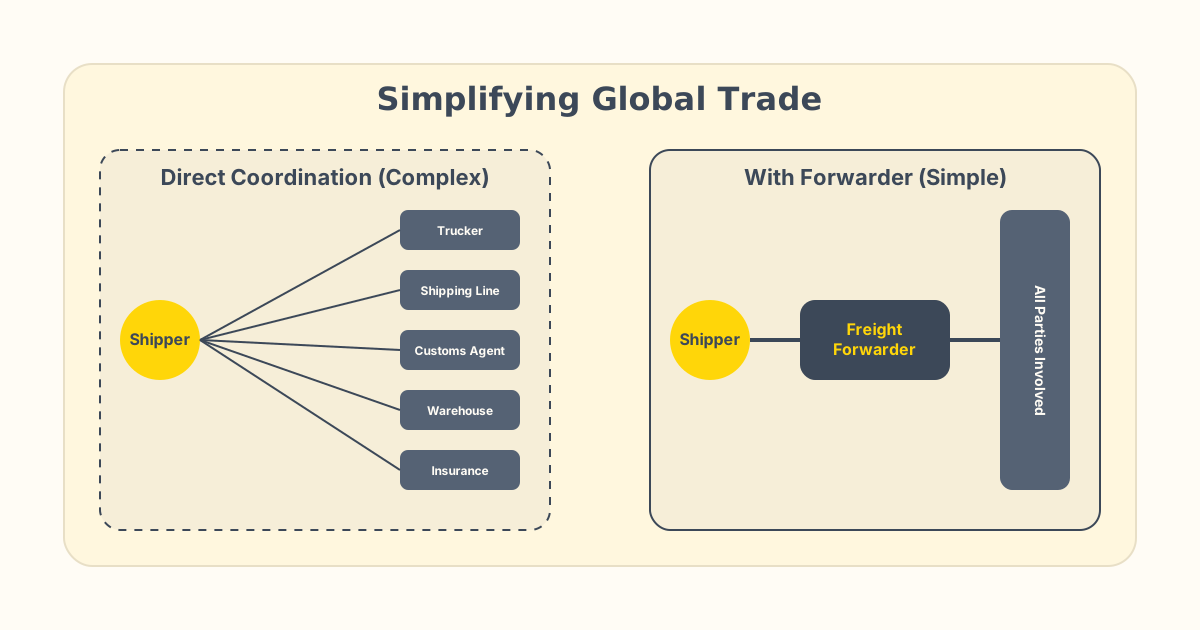
Access to Better Rates
Freight forwarders ship thousands of containers annually, giving them negotiating power you simply don't have as an individual shipper. These volume discounts get passed on to you.
Expertise in Complex Regulations
International shipping involves regulations from:
- Origin country export controls
- Destination country import rules
- Transit country requirements
- International maritime/aviation laws
- Industry-specific regulations (food, pharmaceuticals, hazardous materials)
A freight forwarder navigates all of this so you don't have to.
Risk Management
From cargo insurance to contingency planning, freight forwarders help manage the risks inherent in international trade:
- Alternative routing when ports congest
- Insurance coverage for losses
- Compliance checks to avoid penalties
- Documentation accuracy to prevent delays
Time Savings
Coordinating international shipments yourself means:
- Researching carrier options
- Negotiating rates
- Preparing documentation
- Tracking shipments
- Resolving issues
A freight forwarder handles all of this, freeing you to focus on your business.
Scalability
Whether you're shipping one pallet or a hundred containers, a freight forwarder scales to your needs without you having to build internal logistics expertise.
How to Choose the Right Freight Forwarder
1. Verify Credentials and Licensing
In India, check for:
- IATA membership for air freight services
- Customs broker license if they offer clearance services
- Multimodal Transport Operator (MTO) registration
- Membership in industry associations (FFFAI, ACAAI)
2. Assess Geographic Coverage
Ensure they have strong capabilities in:
- Your origin and destination countries
- Key transhipment hubs
- Your industry's major trade lanes
A freight forwarder with offices or reliable partners in Chennai and Bengaluru can handle South India's major ports efficiently.
3. Evaluate Industry Experience
Different commodities have different requirements:
- Automotive parts need just-in-time delivery
- Pharmaceuticals require temperature control and compliance
- Textiles have specific labelling requirements
- Electronics need secure handling
- Agricultural products require phytosanitary certification
Choose a forwarder experienced in your specific industry.
4. Check Technology Capabilities
Modern freight forwarding requires:
- Online booking and quotation
- Real-time tracking portals
- Electronic documentation
- Integration with your systems (if needed)
5. Assess Communication Quality
Your freight forwarder should:
- Respond promptly to enquiries
- Provide proactive updates
- Explain issues clearly
- Offer solutions, not just problems
6. Understand Their Pricing
Freight forwarder pricing typically includes:
- Freight charges (carrier costs)
- Origin charges (handling, documentation)
- Destination charges (same)
- Forwarding fee (their service charge)
- Additional services (insurance, customs, etc.)
Ask for a detailed quotation breakdown and understand what's included.
7. Request References
Speak with existing clients, particularly those with similar shipping needs. Ask about:
- Reliability and on-time performance
- Problem resolution
- Communication quality
- Overall satisfaction
Freight Forwarding in Chennai and Bengaluru
South India is a major hub for international trade, with Chennai and Bengaluru serving distinct roles:
Chennai
India's gateway to the East and beyond:
- Chennai Port Trust - One of India's largest container ports
- Kamarajar Port (Ennore) - Coal, iron ore, and containers
- Kattupalli Port - Modern container and car terminal
- Inland Container Depot - Rail-connected for hinterland cargo
Chennai handles significant volumes of automobiles, auto parts, textiles, leather goods, and general cargo. Its proximity to manufacturing hubs in Tamil Nadu makes it essential for exporters.
Bengaluru
Karnataka's air cargo powerhouse:
- Kempegowda International Airport - Major air freight hub
- Inland Container Depot - Connected to Chennai by rail
Bengaluru dominates in high-value, time-sensitive cargo - IT equipment, aerospace components, pharmaceuticals, and perishable agricultural products.
A freight forwarder with strong presence in both cities can optimise your shipments between air and sea based on urgency and cost requirements.
Common Freight Forwarding Challenges and How to Avoid Them
Demurrage and Detention Charges
The problem: Containers sitting at port incur daily charges - demurrage (at the terminal) and detention (carrier's container).
The solution: Work with a freight forwarder who:
- Coordinates clearance timing with cargo arrival
- Has relationships to negotiate waiver of charges when delays aren't your fault
- Alerts you early when delays occur
Documentation Errors
The problem: Incorrect documentation causes customs delays, rejected shipments, or penalties.
The solution: A professional freight forwarder:
- Has document checklists for each trade lane
- Reviews everything before submission
- Uses trained documentation specialists
Cargo Damage
The problem: Goods arrive damaged, and you discover carrier liability doesn't cover your loss.
The solution:
- Always insure valuable cargo (don't rely on carrier liability)
- Use a freight forwarder who advises on appropriate coverage
- Document cargo condition before shipping
Hidden Costs
The problem: Your quote didn't include charges that appeared on the final invoice.
The solution:
- Request detailed, all-inclusive quotations
- Ask specifically about: terminal handling, documentation fees, customs charges, last-mile delivery
- Work with transparent freight forwarders who explain costs upfront
Communication Gaps
The problem: You don't know where your cargo is or when problems occur.
The solution:
- Choose a freight forwarder with real-time tracking
- Establish clear communication expectations upfront
- Have a dedicated contact person for your account
The Future of Freight Forwarding
The industry is evolving rapidly:
Digitalisation - Online platforms are making booking and tracking easier, but the expertise of experienced forwarders remains valuable for complex shipments.
Sustainability - Carbon footprint tracking and green shipping options are becoming standard, helping businesses meet environmental commitments.
Visibility - End-to-end tracking with IoT sensors provides real-time location, temperature, and condition monitoring.
Integration - APIs connect freight forwarders directly to clients' ERP systems for seamless order management.
The best freight forwarders combine these technological advances with the human expertise that handles exceptions and solves problems.
Conclusion
A freight forwarder is far more than a booking agent - they're the orchestrator of your international supply chain. From choosing the right carrier and route to handling documentation and managing risks, the right freight forwarder makes global trade accessible and profitable for businesses of any size.
Whether you're importing raw materials or exporting finished products, partnering with an experienced freight forwarder gives you expertise, efficiency, and peace of mind.
Trinity Freight Services has been providing freight forwarding and customs clearing services from Chennai and Bengaluru for over 25 years. We combine global reach with local expertise to keep your cargo moving. Contact us to discuss your freight forwarding needs.